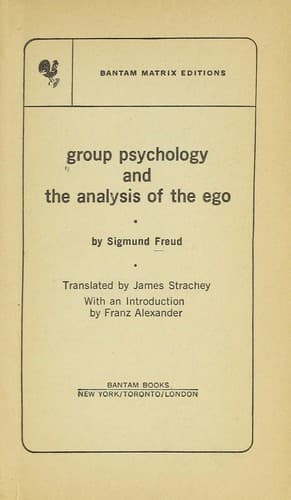
Group Psychology and The Analysis of The EgoFreud, Sigmund
Science
Group Psychology and The Analysis of The Ego
Freud, Sigmund
Ego (Psychology); Psychoanalysis; Social psychology
We are justified in saying that they have been diverted from these
sexual aims, even though there is some difficulty in giving a
representation of such a diversion of aim which will conform to the
requirements of metapsychology. Moreover, those instincts which are
inhibited in their aims always preserve some few of their original
sexual aims; even an affectionate devotee, even a friend or an admirer,
desires the physical proximity and the sight of the person who is now
loved only in the 'Pauline' sense. If we choose, we may recognise in
this diversion of aim a beginning of the _sublimation_ of the sexual
instincts, or on the other hand we may fix the limits of sublimation at
some more distant point. Those sexual instincts which are inhibited in
their aims have a great functional advantage over those which are
uninhibited. Since they are not capable of really complete
satisfaction, they are especially adapted to create permanent ties;
while those instincts which are directly sexual incur a loss of energy
each time they are satisfied, and must wait to be renewed by a fresh
accumulation of sexual libido, so that meanwhile the object may have
been changed. The inhibited instincts are capable of any degree of
admixture with the uninhibited; they can be transformed back into them,
just as they arose out of them. It is well known how easily erotic
wishes develop out of emotional relations of a friendly character, based
upon appreciation and admiration, (compare Molière's 'Embrassez-moi pour
l'amour du grec'), between a master and a pupil, between a performer and
a delighted listener, and especially in the case of women. In fact the
growth of emotional ties of this kind, with their purposeless
beginnings, provides a much frequented pathway to sexual object-choice.
Pfister, in his _Frömmigkeit des Grafen von Zinzendorf_,[72] has given
an extremely clear and certainly not an isolated example of how easily
even an intense religious tie can revert to ardent sexual excitement. On
the other hand it is also very usual for directly sexual tendencies,
short-lived in themselves, to be transformed into a lasting and purely
tender tie; and the consolidation of a passionate love marriage rests
to a large extent upon this process.
Public-domain text, read in full here on John Shaqi.
Reviews
Reviews
No reviews yet
Be the first to share your thoughts on this work.
Elsewhere in the archive
Join the Discussion
Join the discussion
Sign in to leave a comment or review.
Sign InorCreate an account