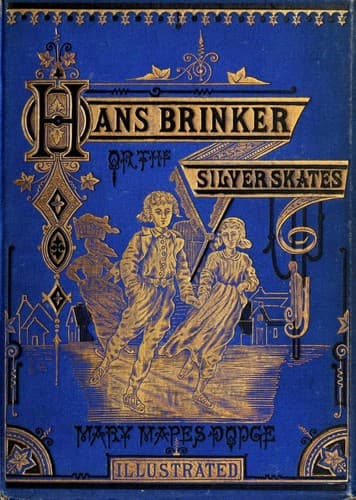
Hans Brinker; Or, The Silver SkatesDodge, Mary Mapes
History
Hans Brinker; Or, The Silver Skates
Dodge, Mary Mapes
Netherlands -- History -- 19th century -- Juvenile fiction; Siblings -- Juvenile fiction; Skating -- Juvenile fiction
The captain was absorbed in thought, at first, for Hans Brinker's sad
story still echoed in his ears. Not until Ludwig rebuked him with a
laughing "Wake up, Grandfather!" did he reassume his position as gallant
boy-leader of his band.
"Ahem! this way, young gentlemen!"
They were walking through the streets of the city, not on a curbed
_sidewalk_, for such a thing is rarely to be found in Holland, but on
the brick pavement that lay on the borders of the cobblestone
carriage-way without breaking its level expanse.
Haarlem, like Amsterdam, was gayer than usual, in honor of St. Nicholas.
A strange figure was approaching them. It was a small man dressed in
black, with a short cloak; he wore a wig and a cocked hat from which a
long crape streamer was flying.
"Who comes here?" cried Ben; "what a queer-looking object."
"That's the aanspreeker," said Lambert; "some one is dead."
"Is that the way men dress in mourning in this country?"
"Oh no. The aanspreeker attends funerals, and it is his business, when
any one dies, to notify all the friends and relatives."
"What a strange custom."
"Well," said Lambert "we needn't feel very badly about this particular
death, for I see another man has lately been born to the world to fill
up the vacant place."
Ben stared. "How do you know that?"
"Don't you see that pretty red pincushion hanging on yonder door?" asked
Lambert in return.
"Yes."
"Well, that's a boy."
"A boy! what do you mean?"
"I mean that here in Haarlem whenever a boy is born, the parents have a
red pincushion put out at the door. If our young friend had been a girl
instead of a boy the cushion would have been white. In some places they
have much more fanciful affairs, all trimmed with lace, and even among
the very poorest houses you will see a bit of ribbon or even a string
tied on the door-latch----"
"Look!" almost screamed Ben, "there _is_ a white cushion, at the door of
that double-jointed house with the funny roof."
"I don't see any house with a funny roof."
"Oh, of course not," said Ben. "I forget you're a native; but all the
roofs are queer to me, for that matter. I mean the house next to that
green building."
"True enough--there's a girl! I tell you what, captain," called out
Lambert, slipping easily into Dutch, "we must get out of this street as
soon as possible. It's full of babies! They'll set up a squall in a
moment."
The captain laughed. "I shall take you to hear better music than that,"
he said; "we are just in time to hear the organ of St. Bavon. The church
is open to-day."
"What, the great Haarlem organ?" asked Ben. "That will be a treat
indeed. I have often read of it, with its tremendous pipes, and its _vox
humana_[21] that sounds like a giant singing."
[Footnote 21: An organ stop which produces an effect resembling the
human voice.]
"The same," answered Lambert van Mounen.
Public-domain text, read in full here on John Shaqi.
Reviews
Reviews
No reviews yet
Be the first to share your thoughts on this work.
Join the Discussion
Join the discussion
Sign in to leave a comment or review.
Sign InorCreate an account