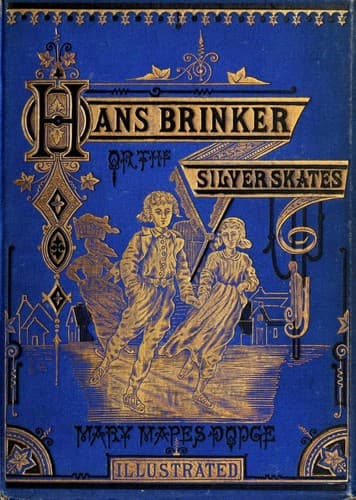
Hans Brinker; Or, The Silver SkatesDodge, Mary Mapes
History
Hans Brinker; Or, The Silver Skates
Dodge, Mary Mapes
Netherlands -- History -- 19th century -- Juvenile fiction; Siblings -- Juvenile fiction; Skating -- Juvenile fiction
"You may well say so. I believe there are one or two organs nowadays
that are said to be as fine; but for years and years this organ of St.
Bavon was the grandest in the world."
"Do you know how large it is?" asked Ben. "I noticed that the church
itself was prodigiously high and that the organ filled the end of the
great aisle almost from floor to roof."
"That's true," said Lambert, "and how superb the pipes looked--just like
grand columns of silver. They're only for show, you know; the _real_
pipes are behind them, some big enough for a man to crawl through, and
some smaller than a baby's whistle. Well, sir, for size, the church is
higher than Westminster Abbey, to begin with, and, as you say, the organ
makes a tremendous show even then. Father told me last night that it is
one hundred and eight feet high, fifty feet broad, and has over five
thousand pipes; it has sixty-four _stops_, if you know what they are,
_I_ don't, and three keyboards."
"Good for you!" said Ben. "You have a fine memory. _My_ head is a
perfect colander for figures; they slip through as fast as they're
poured in. But other facts and historical events stay behind--that's
some consolation."
"There we differ," returned Van Mounen. "I'm great on names and figures,
but history, take it altogether, seems to me to be the most hopeless
kind of a jumble."
Meantime Carl and Ludwig were having a discussion concerning some square
wooden monuments they had observed in the interior of the church; Ludwig
declared that each bore the name of the person buried beneath, and Carl
insisted that they had no names, but only the heraldic arms of the
deceased painted on a black ground, with the date of the death in gilt
letters.
"I ought to know," said Carl, "for I walked across to the east side, to
look for the cannon-ball which mother told me was embedded there. It was
fired into the church, in the year fifteen hundred and something, by
those rascally Spaniards, while the services were going on. There it was
in the wall, sure enough, and while I was walking back, I noticed the
monuments--I tell you they haven't a sign of a name upon them."
"Ask Peter," said Ludwig, only half convinced.
Public-domain text, read in full here on John Shaqi.
Reviews
Reviews
No reviews yet
Be the first to share your thoughts on this work.
Join the Discussion
Join the discussion
Sign in to leave a comment or review.
Sign InorCreate an account