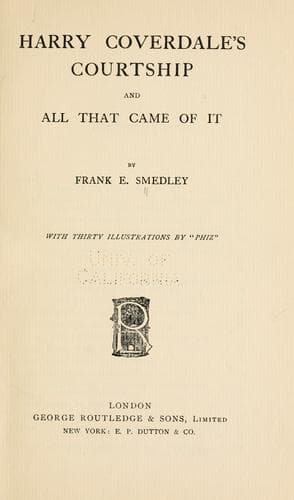
Harry Coverdale's Courtship, and All That Came of ItSmedley, Frank E. (Frank Edward)
General
Harry Coverdale's Courtship, and All That Came of It
Smedley, Frank E. (Frank Edward)
England -- Social life and customs -- 19th century -- Fiction; English fiction -- 19th century
“That lovely _Là ci darem!_ Ah, Alice! if we had but a gentleman’s voice
to take the second! Why _don’t_ you sing, Mr. Coverdale?” exclaimed
Emily, turning over the pages of the duet.
“I’ll try what I can do if _you_ wish it,” was Coverdale’s quiet answer.
Alice, to whom he spoke, glanced at him in speechless surprise; but
Emily, at once making up her mind that he was attempting a hoax, and
eager to turn the tables upon him, resumed--
“Bravo! give me your seat, Alice, I’ll play the accompaniment for you
both.”
Now the truth was, that Harry had been gifted by nature with a rich
powerful voice and excellent ear, qualities which the admiration of his
“set” at Cambridge had induced him to cultivate. When he first started
on his grand tour, he encountered at Florence the mother and sisters of
an old college friend, and those being the days before he had foresworn
young ladies’ society, he was let in for a mild flirtation with one
of the daughters. The “emphatic she” happened to be _fanatica per la
musica_. Accordingly for three months Harry took lessons of the best
master in the place, and sang duets morning, noon, and night; at the end
of which period the “loved one” bolted with a black-bearded native, who
called himself a count, and _was_ a courier. Since which episode, Harry,
disgusted with the whole affair, and all connected with it, had chiefly
confined his singing to lyrical declarations that he would “not go home
till morning.” It will therefore be less a matter of surprise to the
reader, than it was to his audience at the Grange, that Coverdale
performed his part in the duet with equal taste and skill, and very much
better than Alice did hers--that young lady pronouncing her Italian
with rather a midland-county accent than otherwise, although her sweet,
fresh, young voice, in great measure atoned for this little peculiarity.
“Why, Mr. Coverdale, what a charming voice you have, and how beautifully
you sing!” exclaimed Emily, looking at him as if she could not even yet
believe that it was possible he should have so distinguished himself.
“I thought you were hoaxing us, and I sat down to play the duet for the
amiable purpose of exposing your ignorance.”
“How did you acquire such a pure Italian accent?” asked Mrs. Hazlehurst;
“it will be of the greatest advantage to my girls to sing with _you_.”
“I learned of an Italian fellow when I was at Florence, and I suppose he
taught me to do the business all right,” was the careless reply.
“And you have been here more than a week,” continued Mrs. Hazlehurst,
“and allowed Mr. D’Almayne to monopolise both the reading and singing
department, though he cannot fill either one quarter as efficiently as
you are able to do. You really are too diffident.”
“I don’t imagine diffidence to have had very much to do with it,”
observed Kate Marsden, quietly raising her eyes from her work (a crochet
purse with steel beads), and fixing them on Coverdale.
Public-domain text, read in full here on John Shaqi.
Reviews
Reviews
No reviews yet
Be the first to share your thoughts on this work.
Join the Discussion
Join the discussion
Sign in to leave a comment or review.
Sign InorCreate an account