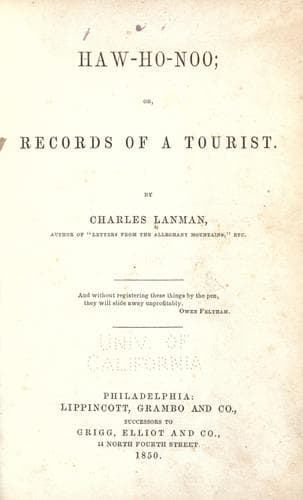
Haw-Ho-Noo; Or, Records of a TouristLanman, Charles
History
Haw-Ho-Noo; Or, Records of a Tourist
Lanman, Charles
Fishing -- North America; United States -- Description and travel
We struck the creek just without the limits of the city, and the first
object that attracted our attention was “Decatur’s tomb.” This memorial
of a departed naval hero occupies the summit of a picturesque hill, and
is shaded from the sun by a brotherhood of handsome oak trees. It is
built of bricks (which are painted white), and resembles in shape a
small Grecian temple without its columns, and is without any
inscription. The remains of the commodore were originally deposited
here, but his ashes have subsequently been removed to Philadelphia and
deposited in his family vault. The land upon which this tomb is located
is called Kalorama, and belongs to an estate originally owned by Joel
Barlow, which fact is alone sufficient to give it a reputation; but it
is somewhat more interesting to know that it was upon this spot of earth
that Robert Fulton first tried his experiments while studying out the
science of steam navigation. This was at the time when Barlow and Fulton
were on the most intimate terms of friendship, and Kalorama was Fulton’s
principal home. A gentleman residing in Georgetown informs us that he
can remember the time when an old wooden shed was standing in the
vicinity of Rock Creek, where Fulton tried many of his experiments; and
we are also informed that the parlor walls of Kalorama were once
ornamented with fresco paintings executed by Fulton at the request of
his friend Barlow. Subsequently to that period and while yet a member of
Barlow’s family, Fulton kept an account-book, in which he recorded all
his business transactions, and that curious and valuable relic of the
departed engineer is now in the possession of a citizen of Washington,
by whose politeness we are privileged to gratify our antiquarian readers
with a brief description of the account-book in question. It is of the
size of an ordinary mercantile cash-book, and although only half filled
with writing, it contains a record of business transactions occurring
during the years 1809,-’10,-’11,-’12,-’13, and ’14. It seems to have
been kept with little regard to method, but nevertheless contains a
great variety of items which are quite valuable in a historical point of
view. On a fly leaf, for example, we have the following record:—
“1813. The dry-dock finished at the steamboat works in Jersey City on
the 14th October. On that day, at 1 o’clock, the original North River
steamboat entered for the first time, and I believe is the first
vessel that has been in a dry-dock in the United States.”:—
With regard to the name of the “original North River steamboat,” I am
not certain; but on the same leaf with the above, I find the following
memorandum:—
“_Car of Neptune_—length of her bottom 157 feet; do. on deck 171 feet
6 inches; extreme width of the bottom 22 feet; do. on deck 26 feet.”
With a view of showing the profitableness of the steam-boating business
in the olden times, I append the following:—
“Total number of passengers in the Raritan for 1809:
Public-domain text, read in full here on John Shaqi.
Reviews
Reviews
No reviews yet
Be the first to share your thoughts on this work.
Elsewhere in the archive
Join the Discussion
Join the discussion
Sign in to leave a comment or review.
Sign InorCreate an account