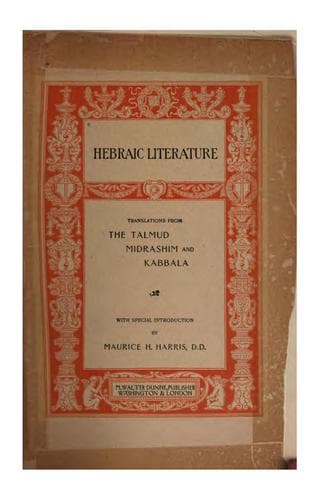
Hebraic Literature; Translations from the Talmud, Midrashim and Kabbala
Religion
Hebraic Literature; Translations from the Talmud, Midrashim and Kabbala
Hebrew literature -- Translations into English
Rabbi Levi said Abraham sits at the gate of hell and does not permit any
circumcised Israelite to enter. But if any appear who happen to have
sinned unduly, these he (by an indescribable contrivance) causes to
become uncircumcised and lets pass without scruple into the region of
torment; and this is what is said in Ps. lv. 20, "He hath put forth his
hands against such as be at peace with him: he hath broken his
covenant."
_Yalkut Shimoni_, fol. 33, col. 2, sec. 18.
Abraham was circumcised on the Day of Atonement, and God looks that day
annually on the blood of the covenant of our father Abraham's
circumcision as atoning for all our iniquities, as it is said in Lev.
xvi. 30, "For on that day shall he make an atonement for you, to cleanse
you from all your sins."
_Yalkut Chadash_, fol. 121, col. 1, sec. 3.
"And it came to pass that when Abram was come into Egypt" (Gen. xii.
14). And where was Sarah? He confined her in a chest, into which he
locked her, lest any one should gaze on her beauty. When he came to the
receipt of custom, he was summoned to open the chest, but declined, and
offered payment of the duty. The officers said, "Thou carriest
garments;" and he offered duty for garments. "Nay, it is gold thou
carriest;" and he offered the impost laid on gold. Then they said, "It
is costly silks, belike pearls, thou concealest;" and he offered the
custom on such articles. At length the Egyptian officers insisted, and
he opened the box. And when he did so, all the land of Egypt was
illumined by her beauty.
_Bereshith Rabba_, chap. 40.
The question may naturally be asked why Abraham hid his wife from the
gaze of others first then and not before. The reply is to be deduced
from the following double rendering of Gen. xii. 11:--"Behold now I know
that thou art a fair woman." As if to say, "Usually people lose their
good looks on a long journey, but thou art as beautiful as ever." The
second explanation is this:--Abraham was so piously modest that in all
his life he never once looked a female in the face, his own wife not
excepted. As he approached Egypt and was crossing some water, he saw in
it the reflection of her face, and it was then that he exclaimed,
"Behold now I know that thou art a fair woman." As the Egyptians are
swarthy, Abraham at once perceived the magnitude of the danger, and
hence his precaution to hide her beauty in a chest.
_Zeenah Ureenah_ (1877 in Russia), fol. 28, col. 1.
Public-domain text, read in full here on John Shaqi.
Reviews
Reviews
No reviews yet
Be the first to share your thoughts on this work.
Join the Discussion
Join the discussion
Sign in to leave a comment or review.
Sign InorCreate an account