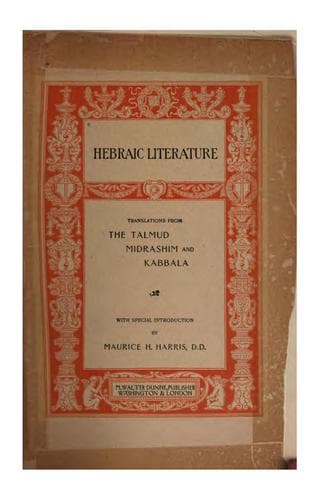
Hebraic Literature; Translations from the Talmud, Midrashim and Kabbala — John Shaqi
Hebraic Literature; Translations from the Talmud, Midrashim and Kabbala
Religion
Hebraic Literature; Translations from the Talmud, Midrashim and Kabbala
Hebrew literature -- Translations into English
When Abraham came to the cave of Machpelah to bury Sarah, Adam and Eve
rose from their grave and protested against his committing her to the
dust in that receptacle. "For," said they, "we are ever ashamed in the
presence of the Holy One--blessed be He!--on account of the sin which we
committed, and now comest thou to add to our shame by the contrast
therewith of the good works which ye two have done." On Abraham's
assurance that he would intercede with God on their behalf that they
should not bear the shame any longer, Adam immediately retired to his
sepulchre, but Eve being still unwilling to do so, Abraham took her by
the hand and led her back to the side of Adam; and then he buried Sarah.
_Yalkut Chadash_, fol. 14, col. 3, sec. 68.
Abraham's father, Terah, was both an idolater, a manufacturer of idols,
and a dealer in them. Once when Terah had some engagement elsewhere he
left his son Abraham to attend to his business. When a customer came to
purchase an idol, Abraham asked him, "How old art thou?" "Lo! so many
years," was the ready reply. "What," exclaimed Abraham, "is it possible
that a man of so many years should desire to worship a thing only a day
old?" The customer, being ashamed of himself, went his way; and so did
all other customers, who underwent a similar inquisition. Once an old
woman brought a measure of fine flour and wished to present it as an
offering to the gods. This so enraged Abraham that he took a staff and
broke all the images, excepting the largest, into whose hands he fixed
the staff. When his father came and questioned him about the destruction
of the gods, he replied, "An old woman placed an offering of flour
before them, which immediately set them all by the ears, for every one
was hungrier than another, but the biggest god killed all the rest with
this staff which thou now seest he still holds in his hands."
Superstition, especially when combined with mercenary motives, knows
neither reason nor human affection, therefore the father handed over his
son Abraham to the inquisition of Nimrod, who threw him into the fiery
furnace, as recorded elsewhere in this Miscellany. This is an historical
fact, to the truth of which the whole orthodox Jewish world will bear
testimony, and is solemnly recorded in _Shalsheleth Hakkabalah_ fol. 2,
col 1.
There are three graces:--The grace of a place in the eyes of its
inhabitants; the grace of a woman in the eyes of her husband; the grace
of a purchase in the eyes of the buyer.
_Soteh_, fol. 47, col. 1.
A man should divide his capital into three parts, and invest one-third
in land, employ one-third in merchandise, and reserve one-third in ready
money.
_Bava Metzia_, fol. 42, col. 1.
All who go down to hell shall come up again, except these three:--He who
commits adultery; he who shames another in public; and he who gives
another a bad name.
Ibid., fol. 58, col. 2.
Public-domain text, read in full here on John Shaqi.
Reviews
Reviews
No reviews yet
Be the first to share your thoughts on this work.
Join the Discussion
Join the discussion
Sign in to leave a comment or review.
Sign InorCreate an account