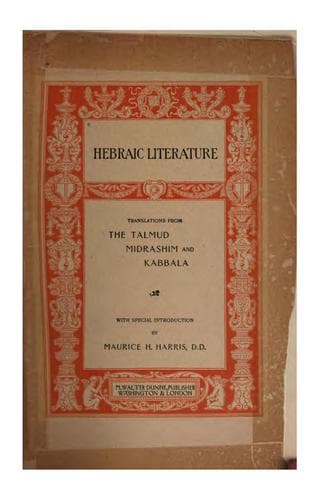
Hebraic Literature; Translations from the Talmud, Midrashim and Kabbala
Religion
Hebraic Literature; Translations from the Talmud, Midrashim and Kabbala
Hebrew literature -- Translations into English
The Rabbis have taught, a man should not sell to his neighbor shoes made
from the hide of a beast that has died of disease, as if of a beast that
had been slaughtered in the shambles, for two reasons: first, because he
imposes on him (for the skin of a beast that dies of itself is not so
durable as the hide of a slaughtered animal); second, because there is
danger (for the beast that died of itself might have been stung by a
serpent, and the poison remaining in the leather might prove fatal to
the wearer of shoes made of that leather). A man should not send his
neighbor a barrel of wine with oil floating upon its surface; for it
happened once that a man did so, and the recipient went and invited his
friends to a feast, in the preparation of which oil was to form a chief
ingredient; but when the guests assembled, it was found out that the
cask contained wine, and not oil; and because the host had nothing else
in preparation for a worthy feast, he went and committed suicide.
Neither should guests give anything from what is set before them to the
son or daughter of their host, unless the host himself give them leave
to do so; for it once happened during a time of scarcity that a man
invited three of his friends to dine, and he had nothing but three eggs
to place before them. Meanwhile, as the guests were seated at the board,
the son of the host came into the room, and first one of the guests gave
him his share, and then the other two followed his example. Shortly
afterward the host himself came in, and seeing the child with his mouth
full and both hands, he knocked him down to the ground, so that he died
on the instant. The mother, seeing this, went and threw herself
headlong, from the housetop, and the father followed her example. Thus
Rabbi Eliezar ben Yacob said, "There perished in this affair three souls
of Israel."
Ibid., fol. 94, col. 1.
Public-domain text, read in full here on John Shaqi.
Reviews
Reviews
No reviews yet
Be the first to share your thoughts on this work.
Join the Discussion
Join the discussion
Sign in to leave a comment or review.
Sign InorCreate an account