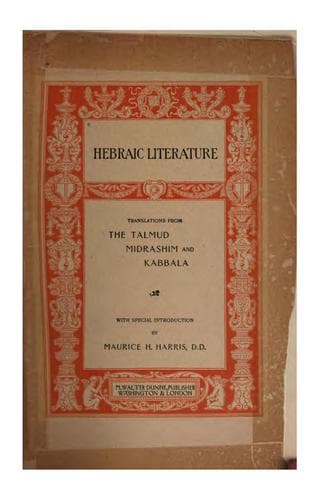
Hebraic Literature; Translations from the Talmud, Midrashim and Kabbala
Religion
Hebraic Literature; Translations from the Talmud, Midrashim and Kabbala
Hebrew literature -- Translations into English
"I once, when a grave-digger," says Abba Shaul, as the Rabbis relate,
"chased a roe which had entered the shinbone of a dead man; and though I
ran three miles after it, I could not overtake it, nor reach the end of
the bone. When I returned, I was told that it was a bone of Og, king of
Bashan."
_Niddah_, fol. 24, col. 2.
The Rabbis have taught that during the first three months (of pregnancy)
the child lies in the lower part (of the uterus); during the next three
it occupies the middle part; and during the last three it is in the
upper part; and that when the time of parturition comes, it turns over
first, and this causes the birth-pains. We are also taught that the
pains caused by a female child are greater than those caused by a male.
Rabbi Elazar said, "What Scripture is there for this? 'When I was made
in secret and curiously wrought, in the lowest parts of the earth' (Ps.
cxxxix. 15). It is not said, 'I abode,' but, 'I was curiously wrought.'
Why the difference? Why are the pains caused by a girl greater than
those caused by a boy?"
Ibid., fol. 31, col. 1.
The Rabbis teach there are three that have a share in a man; God, and
his father and mother. The father's part consists of all that is white
in him--the bones, the veins, the nails, the brain, and the white of the
eye. The mother's part consists of all that is red in him--the skin, the
flesh, the hair, and the black part of the eye. God's part consists of
the breath, the soul, the physiognomy, sight and hearing, speech, motive
power, knowledge, understanding, and wisdom. And when the time comes
that the man should depart from the world, God takes away His part, and
leaves those which belong to the father and mother. Rav Pappa says,
"This is the meaning of the proverb, 'Shake off the salt and throw the
flesh to the dogs.'"
_Niddah_, fol. 31. col. 1.
Rashi's explanatory note is this: "Shake off the salt from the
flesh and it becomes fit only for dogs. The soul is the salt
which preserves the body; when it departs, the body putrefies."
Four things require fortitude in the observance:--The law, good works,
prayer, and social duties. Respecting the law and good works it is
written (Josh. i. 7), "Be thou strong and firm, that thou mayest observe
to do all the law;" in which the word "strong" refers to the law, and
the word "firm" to good works. Of prayer it is written, "Wait on the
Lord; be strong, and He shall make thine heart firm; wait, I say, upon
the Lord" (Ps. xxvii. 14). In respect to social duties it is written (2
Sam. x. 2), "Be strong, and let us strengthen ourselves for our people,
and for the cities of our God."
_Berachoth_, fol. 32, col. 2.
There are four signs which tell tales:--Dropsy is a sign of sin;
jaundice is a sign of hatred without a cause; poverty is a sign of
pride; and quinsy is a sign of slander.
_Shabbath_, fol. 33, col. 1.
Public-domain text, read in full here on John Shaqi.
Reviews
Reviews
No reviews yet
Be the first to share your thoughts on this work.
Join the Discussion
Join the discussion
Sign in to leave a comment or review.
Sign InorCreate an account