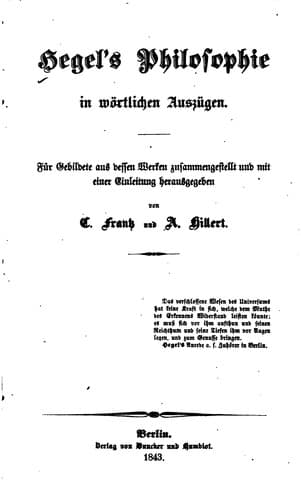
Hegel's Lectures on the History of Philosophy: Volume 3 (of 3)Hegel, Georg Wilhelm Friedrich
PhilosophyPhilosophy
Hegel's Lectures on the History of Philosophy: Volume 3 (of 3)
Hegel, Georg Wilhelm Friedrich
Philosophy -- History
Amongst those who wished to give additional proof of the doctrines of
the Church through thought, is Anselm, a man of great distinction and
high repute. He was born at Aosta, in Piedmont, about 1034; in 1060 he
became a monk at Bec, and in 1093 was raised to the rank of Archbishop
of Canterbury; in 1109 he died.[19] He sought to consider and prove
philosophically the doctrines of the Church, and it has even been said of
him that he laid the basis for scholastic philosophy.
He speaks as follows of the relation of faith to thought: “Our faith
must be defended by reason against the godless, and not against those
who glory in the name of Christian; for of these we may rightly demand
that they should hold firm to the obligations which they came under in
baptism. Those others must be shown through reason how irrationally
they strive against us. The Christian must go on through faith to
reason, and not come from reason to faith; but if he cannot attain to
comprehension, he must still less depart from faith. For if he is able to
press on to knowledge, he rejoices therein; when he is unable so to do,
he humbly adores.”[20] He makes a noteworthy remark, which contains his
whole philosophy, in his work _Cur Deus homo_ (I. 2), which is rich in
speculative thought: “It appears to me great negligence if we are firm
in the faith, and do not seek also to comprehend what we believe.” Now
this is declared to be arrogance; immediate knowledge, faith, is held to
be higher than knowledge. But Anselm and the scholastics maintained the
opposite view.
Public-domain text, read in full here on John Shaqi.
Reviews
Reviews
No reviews yet
Be the first to share your thoughts on this work.
Elsewhere in the archive
Join the Discussion
Join the discussion
Sign in to leave a comment or review.
Sign InorCreate an account