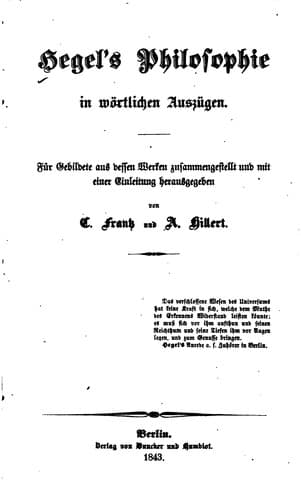
Hegel's Lectures on the History of Philosophy: Volume 3 (of 3)Hegel, Georg Wilhelm Friedrich
PhilosophyPhilosophy
Hegel's Lectures on the History of Philosophy: Volume 3 (of 3)
Hegel, Georg Wilhelm Friedrich
Philosophy -- History
This mode of arguing held good until the time of Kant; and we see in it
the endeavour to apprehend the doctrine of the Church through reason.
This opposition between Being and thought is the starting point in
philosophy, the absolute that contains the two opposites within itself—a
conception, according to Spinoza, which involves its existence likewise.
Of Anselm it is however to be remarked that the formal logical mode of
the understanding, the process of scholastic reasoning is to be found
in him, the content indeed is right, but the form faulty. For in the
first place the expression “the thought of a Highest” is assumed as
the _prius_. Secondly, there are two sorts of objects of thought—one
that is and another that is not; the object that is only thought and
does not exist, is as imperfect as that which only is without being
thought. The third point is that what is highest must likewise exist.
But what is highest, the standard to which all else must conform, must
be no mere hypothesis, as we find it represented in the conception of a
highest acme of perfection, as a content which is thought and likewise
_is_. This very content, the unity of Being and thought, is thus indeed
the true content; but because Anselm has it before him only in the form
of the understanding, the opposites are identical and conformable to
unity in a third determination only—the Highest—which, in as far as
it is regulative, is outside of them. In this it is involved that we
should first of all have subjective thought, and then distinguished from
that, Being. We allow that if we think a content (and it is apparently
indifferent whether this is God or any other), it may be the case that
this content does not exist. The assertion “Something that is thought
does not exist” is now subsumed under the above standard and is not
conformable to it. We grant that the truth is that which is not merely
thought but which likewise is. But of this opposition nothing here is
said. Undoubtedly God would be imperfect, if He were merely thought and
did not also have the determination of Being. But in relation to God
we must not take thought as merely subjective; thought here signifies
the absolute, pure thought, and thus we must ascribe to Him the quality
of Being. On the other hand if God were merely Being, if He were not
conscious of Himself as self-consciousness, He would not be Spirit, a
thought that thinks itself.
Public-domain text, read in full here on John Shaqi.
Reviews
Reviews
No reviews yet
Be the first to share your thoughts on this work.
Elsewhere in the archive
Join the Discussion
Join the discussion
Sign in to leave a comment or review.
Sign InorCreate an account