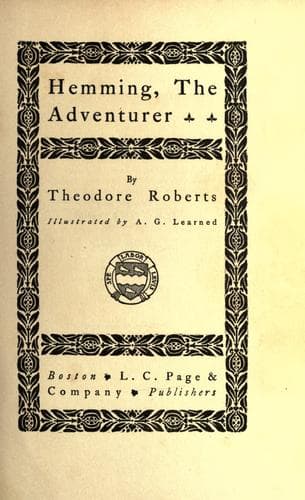
Hemming, the adventurerRoberts, Theodore Goodridge
General
Hemming, the adventurer
Roberts, Theodore Goodridge
Canadian fiction -- 20th century
"I will admit anything in his favour," replied Hemming, "but as for
his shooting, why, thank Heaven, I have never tested it."
"Wasn't he very rude to you one night?" she asked.
He laughed quietly. "The circumstances warranted it, but he was rude
to the wrong person, don't you think?"
"No, indeed," she cried, "for no matter how minus a quantity your
guilt, or how full of fault I had been, it would never have done for
him to threaten me with a--" She paused.
"Service revolver?" said Hemming, "and one of my own at that."
"Fever is a terrible thing," she said, gazing at the red heart of the
claret.
"My dear sister," said the Englishman, "a man would gladly suffer
more to win less."
They smiled frankly into one another's eyes.
"Then you do not think too badly of me?" she asked.
"I think everything that is jolly--of both of you," he replied.
"I like your friendship," she said, "for, though you seem such a good
companion, I do not believe you give it lightly."
After the coffee and an aimless talk with Tetson, Hemming looked in
at Hicks and found him drinking chicken broth as if he liked it. The
invalid was strong enough to manage the spoon himself, but Marion
held the bowl. Hemming went to his own room, turned on the light
above his desk, and began to write. He worked steadily until ten
o'clock. Then he walked up and down the room for awhile, rolling and
smoking cigarettes. The old ambition had him in its clutches.
Pernamba, with its heat, its dulness, its love and hate, had faded
away. Now he played a bigger game--a game for the world rather than
for half a battalion of little brown soldiers. A knock sounded on
his door, and, before he could answer it, Captain Santosa, glorious
in his white and gold, stepped into the room. The sight of the
Brazilian brought his dreams to the dust. "Damn," he said, under his
breath.
Then he waved his subordinate to a seat.
The captain's manner was as courteous as ever, his smile as urbane,
his eyes as unfathomable. But his dusky cheek showed an unusual
pallor, and as he sat down he groaned. Hemming eyed him sharply; men
like Santosa do not groan unless they are wounded--maybe in their
pride, by a friend's word, maybe in their vitals by an enemy's knife.
There was no sign of blood on the spotless uniform.
"A drink?" queried Hemming, turning toward the bell.
"Not now," said the captain, "but afterward, if you then offer it to
me." He swallowed hard, looked down at his polished boots, aloft at
the ceiling, and presently at his superior officer's staring
eye-glass. From this he seemed to gather courage.
Public-domain text, read in full here on John Shaqi.
Reviews
Reviews
No reviews yet
Be the first to share your thoughts on this work.
Elsewhere in the archive
Join the Discussion
Join the discussion
Sign in to leave a comment or review.
Sign InorCreate an account