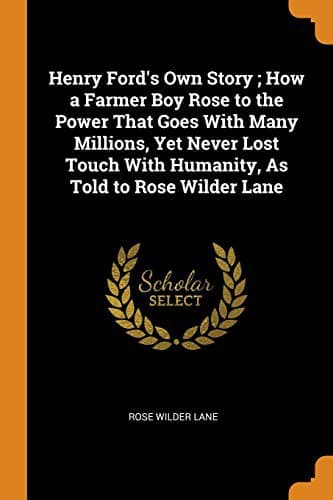
Henry Ford's Own Story: How a Farmer Boy Rose to the Power that goes with Many Millions, Yet Never Lost Touch with HumanityLane, Rose Wilder
Philosophy
Henry Ford's Own Story: How a Farmer Boy Rose to the Power that goes with Many Millions, Yet Never Lost Touch with Humanity
Lane, Rose Wilder
Automobile industry and trade -- United States -- History; Businesspeople -- United States -- Biography; Ford, Henry, 1863-1947
It was a busy week. Ford and Cooper bent every energy to teaching
Oldfield how to drive the car. They crammed his mind with a mass of
facts about the motor, the factor of safety in making quick turns, the
way to handle the steering lever. On the day before the races he took
the car out on the tracks and made one circuit safely, holding it down
to slow speed.
"I can handle her all right. I'll let her out to-morrow," he reported.
The day of the track meeting dawned. Ford and Cooper, tense with
anxiety, went over the car thoroughly and coached Oldfield for the last
time. Couzens, hiding his nervousness under a bland, confident manner,
gathered his group of business men and took them into the grandstand.
The free-for-all was called.
Half a dozen cars were entered. When they had found their places in the
field Barney Oldfield settled himself in his seat, firmly grasped the
two-handed tiller which steered the mighty car, and remarked, "Well,
this chariot may kill me, but they'll say afterward that I was going
some when the car went over the bank."
Ford cranked the engine, and the race was on.
Oldfield, his long hair snapping in the wind, shot from the midst of the
astounded field like a bullet. He did not dare look around; he merely
clung to the tiller and gave that car all the power it had. At the end
of the first half mile he was far in the lead and gaining fast.
The crowd, astounded, hysterical with excitement, saw him streak past
the grandstand a quarter of a mile ahead of the nearest car following.
On the second lap he still gained. Grasping the tiller, never for a
second relaxing that terrific speed, he spun around the course again,
driving as if the field was at his heels.
He roared in at the finish, a full half mile ahead of the nearest car,
in a three-mile race.
News of the feat went around the world, and in one day Ford was hailed
as a mechanical genius.
Couzens brought the group of business men down to the track, and before
Oldfield was out of the car they had made an appointment to meet Ford
next day and form a company. The race had convinced them.
"Some people can't see a thing unless it is written in letters a mile
high and then illustrated with a diagram," Ford says meditatively.
During the following week a company was formed, and Ford was made
vice-president, general manager, superintendent, master mechanic and
designer. He held a small block of stock and was paid a salary of $150 a
month, the same amount he had drawn while working for the Edison
company.
He was satisfied. The salary was plenty for his needs; apparently he
waved that subject aside as of little importance. At last, he thought,
he had an opportunity to put into practice his plans for manufacturing,
to build up an organization which was to be as much a Ford factor as his
car was a Ford car.
Public-domain text, read in full here on John Shaqi.
Reviews
Reviews
No reviews yet
Be the first to share your thoughts on this work.
Elsewhere in the archive
Join the Discussion
Join the discussion
Sign in to leave a comment or review.
Sign InorCreate an account