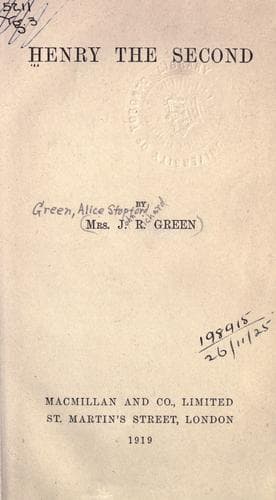
Great Britain -- History -- Henry II, 1154-1189; Henry II, King of England, 1133-1189
But no kiss of peace given at Henry's orders could turn away the rising
wrath of the Church. A general feeling of danger was in the air, and both
sides, in preparing for the inevitable future, chose the same man to
fight their battle,--Thomas, the disciple and secretary of Theobald,
Thomas, the minister of the king's reforms. The young king had turned
with passionate affection to his brilliant chancellor. In hall, in
church, in council-chamber, on horseback, he was never separated from his
friend. Thomas, like his master, was always ready for hunting, or for
hawking, or for a game of chess. He was willing, too, to save the king
the cost and burden of entertainment and display. He was careful to
magnify his office. He held a splendid court, where Henry's son and a
train of young nobles were brought up to knightly accomplishments. He was
dressed in scarlet and furs, and his clothes were woven with gold. His
table was covered with gold and silver plate, and his servants had orders
to buy the most costly provisions in the shops for cooked meat, which
were then the glory of the city. His household was the talk of London.
The king himself, curious to see how things went on, would sometimes come
on horseback to watch the chancellor sitting at meat, or, bow in hand,
would turn in on his way from hunting, and, vaulting over the table,
would sit down and eat with him. Henry lavished gifts on him, so that
according to one of his chroniclers, "when he might have had all
the churches and castles of the kingdom if he chose since there was none
to deny him, yet the greatness of his soul conquered his ambition; he
magnanimously disdained to take the poorer benefices, and required only
the great things--the provostship of Beverley, the deanery at Hastings,
the Tower of London with the service of the soldiers belonging to it, the
castle of Eye with 140 soldiers, and that of Berkhampstead." or was the
king's favour misplaced, for Thomas was an excellent servant. Business
was rapidly despatched by him; and Henry found himself relieved of the
most irksome part of his work. The chancellor surrounded himself by
able men, looking even as far as Gaul for poor Englishmen who were
distinguished for their talent; fifty-two clerks were employed under him
in the Chancery. As he grew more and more important to his master,
unlimited powers were put in his hand. There are even entries in the Pipe
Roll of pardons issued by him, the first instance of such a right ever
used by any save king or queen. It was said that those who had the king's
favour might count it as a vain thing, unless they had also the friendship
of the chancellor. "The king's dominions, which reach from the Arctic
Ocean to the Pyrenees, he put into your power, and in this alone was any
man thought happy, that he should find favour in your eyes," runs a letter
written afterwards to Thomas.
Public-domain text, read in full here on John Shaqi.
Reviews
Reviews
No reviews yet
Be the first to share your thoughts on this work.
Join the Discussion
Join the discussion
Sign in to leave a comment or review.
Sign InorCreate an account