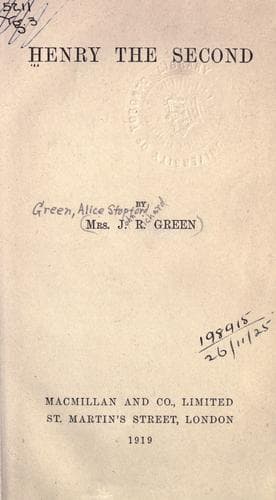
Great Britain -- History -- Henry II, 1154-1189; Henry II, King of England, 1133-1189
In the January of 1163 Henry once more landed in England. His absence off
our and a half years had given time for dangers and alarms to spring up
in the half-settled realm. Mysterious prophecies passed from mouth to
mouth that the king would never be seen in the island again, and even
Theobald, before his death in 1161, had sent urgent entreaties for his
return. The king had, in fact, during the first eight years of his rule
been mainly occupied in building up his empire, and providing for its
defence against external dangers. He had only twice visited the kingdom,
each time for little more than a year. He was now, however, prepared to
take the work of administration seriously in hand. In the next eighteen
years, from 1163 to 1180, he landed on its shores seven times, and spent
altogether eight years in the country. Once he was busied with the
conquest of Ireland; one visit of a month was spent in crushing a
dangerous rebellion; but with these two exceptions every coming of the
king was marked by the carrying out of some great administrative reform.
In his half-compacted empire order was still only maintained by his
actual presence and the sheer force of his personal authority, as he
hurried from country to country to quell a rising in Gascony or a revolt
in Galloway, to wage war in Wales, to finish the conquest of Britanny or
of Ireland, to order the administration of Poitou or Normandy. But in the
swift and terrible progresses of a king who visited the shires to north
and south and west in the intervals of foreign war, a long series of
experiments as to the best forms of internal government was ceaselessly
carried out, and the new administration securely established.
Henry, however, was at once met by a difficulty unknown to earlier days.
The system which the Conqueror had established of separate courts for
secular and ecclesiastical business had utterly broken down for purposes
of justice. Until the reign of Stephen much of the business of the
bishops was done in the courts of the hundred and the shire. The Church
courts also had at first been guided by the customary law and traditions
of the early English Church, which had grown up along with the secular
laws and had a distinctly national character. So long, indeed, as the
canon law remained somewhat vague, and the Church courts incomplete, they
could work peaceably side by side with the lay courts; but with the
development of ecclesiastical law in the middle of the twelfth century,
it was inevitable that difficulties should spring up. The boundaries of
civil and ecclesiastical law were wholly uncertain, the scientific study
of law had hardly begun, and there was much debatable ground which might
be won by the most arrogant or the most skilful of the combatants. Every
brawl of a few noisy lads in the Oxford streets or at the gates of some
cathedral or monastic school was enough to kindle the strife as to the
jurisdiction of Church or State which shook medieval society to its
foundation.
Public-domain text, read in full here on John Shaqi.
Reviews
Reviews
No reviews yet
Be the first to share your thoughts on this work.
Join the Discussion
Join the discussion
Sign in to leave a comment or review.
Sign InorCreate an account