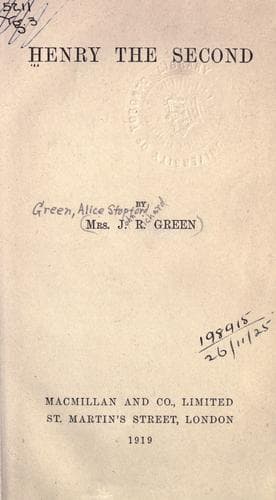
Great Britain -- History -- Henry II, 1154-1189; Henry II, King of England, 1133-1189
The inevitable controversy declared itself soon after the return of
Thomas from Tours. Throughout July and August one question after another
was hurried forward for settlement between king and primate. On July 1
the king proposed a change in the collection of the land tax, which
would have increased the royal revenues at the expense of the revenues
of the shire. Since the Conquest there had never been a single instance
of an attempt to resist the royal will in matters of finance, but Thomas
showed no hesitation. He flatly refused consent to an arbitrary act of
this kind. He made no objection to the payment of the tax, but he was
determined to prevent the local revenues being seized in this way by the
king. His action seems to have been wise and patriotic, and his triumph
was complete. Henry was forced to abandon the scheme. Having awakened
the anger of the king, Thomas next alienated the whole party of the
barons by pressing his demands for the recovery of lands belonging to
his see. Tunbridge, Rochester, now in the custody of the crown itself,
Hythe, Saltwood, and a number of other manors became the subjects of
sharp contention. The archbishop urged a doubtful claim, which he had
inherited from Theobald, to appoint the priest to a church on the land
of William of Eynesford, a tenant of the king. William resisted, and
Thomas made his first false move by excommunicating him. Henry at once
appealed to the "customs" of the kingdom, which forbade such sentence on
the king's barons without the royal consent, and Thomas had to withdraw
his excommunication. "I owe him no thanks for it!" cried the angry king.
Public-domain text, read in full here on John Shaqi.
Reviews
Reviews
No reviews yet
Be the first to share your thoughts on this work.
Elsewhere in the archive
Join the Discussion
Join the discussion
Sign in to leave a comment or review.
Sign InorCreate an account