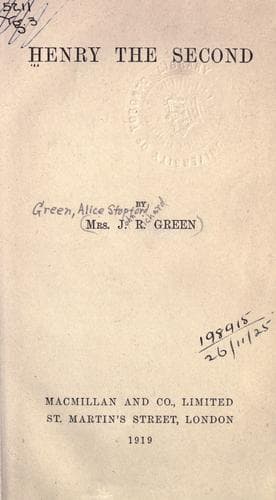
Great Britain -- History -- Henry II, 1154-1189; Henry II, King of England, 1133-1189
De Lucy, and of Jocelyn de Bailleul, a French lawyer. In any case he
frankly denied the authority of "custom," that tyrannous law of medieval
times. "God never said," writes one of his defenders, "I am Custom, but I
am Truth." Thomas rested his case not on the customary law of the land,
but on the code of Rome; to English tradition he opposed the Italian
lawyers. Henry, on his part, declared that the Constitutions were drawn
up by the common witness of bishops, earls, barons, and wise men; that
they were, in fact, part of a system actually in operation, and which had
been administered by Thomas himself when he was chancellor. It was
certainly a startling novelty to have the customs of the realm drawn up in
a written code to which men were required to swear obedience; but still
the "Constitutions" professed to be no new legislation, but to be simply a
statement of recognized national tradition. The changes that had followed
on the Conquest had modified older customs profoundly. The conditions, not
only of England but of Europe, had changed with confusing rapidity, and it
was no longer easy to say exactly what was "custom" and what was not. To
Henry the Constitutions did fairly represent the system which had grown up
with general consent under the Norman kings. Thomas, on the other hand,
might argue with equal conviction that he was asked to sign as "customs"
what was practically a new code; and he had neither the wisdom nor the
temper to reconcile the dispute by a reasonable compromise.
No question seems to have been raised as to some of the statutes which
were certainly of recent growth, though they touched Church interests.
One of these repeated unreservedly the assertion that bishops held a
feudal position in all points the same as that of barons or direct
vassals of the king, being bound by all their obligations, and entitled
to sit with them in judgment in the Curia Regis till it came to a
question of blood. Others dealt with disorders which had grown up from
the mutual jealousy of Church and lay courts, and the difficulties thus
thrown in the way of administering laws which were not disputed; rules
were made for the securities to be taken from excommunicated persons;
for the giving up to the king of forfeited goods of felons deposited in
churches or churchyards; and forbidding the ordination of villeins
without their lord's consent,--a provision which possibly was intended
to prevent the withdrawal of an unlimited number of people from secular
jurisdiction. Two other clauses touched upon the new legal remedies, the
use of the jury in the accusation of criminals, and in the decision of
questions of property; it was decreed that laymen should not be accused
in Church courts save by lawful witness, or by the twelve legal
men of the hundred--in other words, by the newly-developed jury of
"presentation"; while the jury of "recognition" was ordered to be used
in disputed titles to ecclesiastical estates.
Public-domain text, read in full here on John Shaqi.
Reviews
Reviews
No reviews yet
Be the first to share your thoughts on this work.
Elsewhere in the archive
Join the Discussion
Join the discussion
Sign in to leave a comment or review.
Sign InorCreate an account