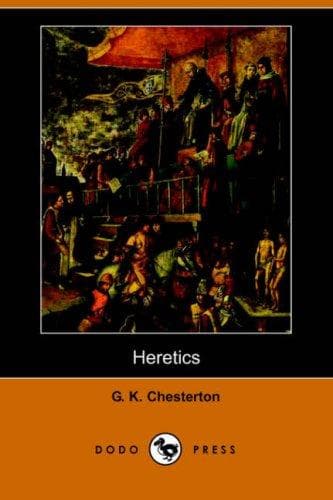
Apologetics; Chesterton, G. K. (Gilbert Keith), 1874-1936
As one of the enormous follies of folk-lore, let us take the case of
the transmigration of stories, and the alleged unity of their source.
Story after story the scientific mythologists have cut out of its place
in history, and pinned side by side with similar stories in their
museum of fables. The process is industrious, it is fascinating, and
the whole of it rests on one of the plainest fallacies in the world.
That a story has been told all over the place at some time or other,
not only does not prove that it never really happened; it does not even
faintly indicate or make slightly more probable that it never happened.
That a large number of fishermen have falsely asserted that they have
caught a pike two feet long, does not in the least affect the question
of whether any one ever really did so. That numberless journalists
announce a Franco-German war merely for money is no evidence one way or
the other upon the dark question of whether such a war ever occurred.
Doubtless in a few hundred years the innumerable Franco-German wars
that did not happen will have cleared the scientific mind of any belief
in the legendary war of ’70 which did. But that will be because if
folk-lore students remain at all, their nature will be unchanged; and
their services to folk-lore will be still as they are at present,
greater than they know. For in truth these men do something far more
god-like than studying legends; they create them.
There are two kinds of stories which the scientists say cannot be true,
because everybody tells them. The first class consists of the stories
which are told everywhere, because they are somewhat odd or clever;
there is nothing in the world to prevent their having happened to
somebody as an adventure any more than there is anything to prevent
their having occurred, as they certainly did occur, to somebody as an
idea. But they are not likely to have happened to many people. The
second class of their “myths” consist of the stories that are told
everywhere for the simple reason that they happen everywhere. Of the
first class, for instance, we might take such an example as the story
of William Tell, now generally ranked among legends upon the sole
ground that it is found in the tales of other peoples. Now, it is
obvious that this was told everywhere because whether true or
fictitious it is what is called “a good story;” it is odd, exciting,
and it has a climax. But to suggest that some such eccentric incident
can never have happened in the whole history of archery, or that it did
not happen to any particular person of whom it is told, is stark
impudence. The idea of shooting at a mark attached to some valuable or
beloved person is an idea doubtless that might easily have occurred to
any inventive poet. But it is also an idea that might easily occur to
any boastful archer. It might be one of the fantastic caprices of some
story-teller. It might equally well be one of the fantastic caprices of
some tyrant.
Public-domain text, read in full here on John Shaqi.
Reviews
Reviews
No reviews yet
Be the first to share your thoughts on this work.
Elsewhere in the archive
Join the Discussion
Join the discussion
Sign in to leave a comment or review.
Sign InorCreate an account