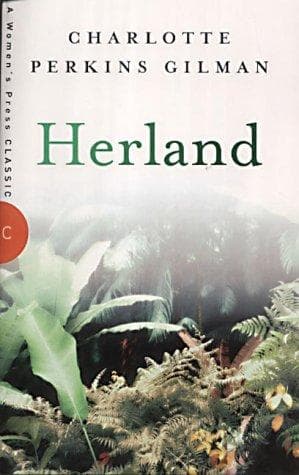
Black humor; Utopian fiction; Utopias -- Fiction; Women -- Fiction
“Why, Van,” she said, holding out her hands to me. “Why Van--darling!
How splendid of you to feel it so keenly. That’s what we all want, of
course--Peace and Beauty, and Comfort and Love--with God! And Progress
too, remember; Growth, always and always. That is what our religion
teaches us to want and to work for, and we do!”
“But that is _here_,” I said, “only for this life on earth.”
“Well? And do not you in your country, with your beautiful religion of
love and service have it here, too--for this life--on earth?”
None of us were willing to tell the women of Herland about the evils of
our own beloved land. It was all very well for us to assume them to
be necessary and essential, and to criticize--strictly among
ourselves--their all-too-perfect civilization, but when it came to
telling them about the failures and wastes of our own, we never could
bring ourselves to do it.
Moreover, we sought to avoid too much discussion, and to press the
subject of our approaching marriages.
Jeff was the determined one on this score.
“Of course they haven’t any marriage ceremony or service, but we can
make it a sort of Quaker wedding, and have it in the temple--it is the
least we can do for them.”
It was. There was so little, after all, that we could do for them. Here
we were, penniless guests and strangers, with no chance even to use
our strength and courage--nothing to defend them from or protect them
against.
“We can at least give them our names,” Jeff insisted.
They were very sweet about it, quite willing to do whatever we asked, to
please us. As to the names, Alima, frank soul that she was, asked what
good it would do.
Terry, always irritating her, said it was a sign of possession. “You are
going to be Mrs. Nicholson,” he said. “Mrs. T. O. Nicholson. That shows
everyone that you are my wife.”
“What is a ‘wife’ exactly?” she demanded, a dangerous gleam in her eye.
“A wife is the woman who belongs to a man,” he began.
But Jeff took it up eagerly: “And a husband is the man who belongs to
a woman. It is because we are monogamous, you know. And marriage is the
ceremony, civil and religious, that joins the two together--‘until death
do us part,’” he finished, looking at Celis with unutterable devotion.
“What makes us all feel foolish,” I told the girls, “is that here we
have nothing to give you--except, of course, our names.”
“Do your women have no names before they are married?” Celis suddenly
demanded.
“Why, yes,” Jeff explained. “They have their maiden names--their
father’s names, that is.”
“And what becomes of them?” asked Alima.
“They change them for their husbands’, my dear,” Terry answered her.
“Change them? Do the husbands then take the wives’ ‘maiden names’?”
“Oh, no,” he laughed. “The man keeps his own and gives it to her, too.”
“Then she just loses hers and takes a new one--how unpleasant! We won’t
do that!” Alima said decidedly.
Public-domain text, read in full here on John Shaqi.
Reviews
Reviews
No reviews yet
Be the first to share your thoughts on this work.
Elsewhere in the archive
Join the Discussion
Join the discussion
Sign in to leave a comment or review.
Sign InorCreate an account