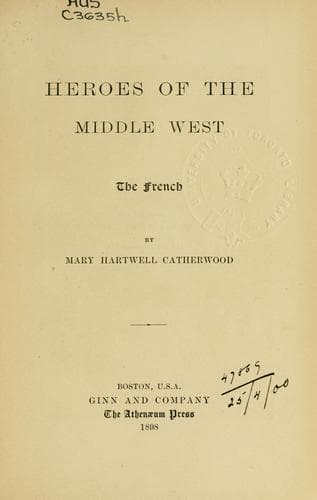
Heroes of the Middle West: The FrenchCatherwood, Mary Hartwell
History
Heroes of the Middle West: The French
Catherwood, Mary Hartwell
Mississippi River Valley -- Discovery and exploration; Mississippi River Valley -- History -- To 1803
La Salle had learned from the Iroquois about the Ohio River. But the
region through which it flowed to the Mississippi remained for a long
while an unbroken wilderness. The English settlements on their strip of
Atlantic coast, however, and the French settlements in the west, reached
gradually out over this territory and met and grappled. Whichever power
got and kept the mastery of the west would get the mastery of the
continent.
The territory of Kentucky, like that of Michigan, was owned by no tribe
of Indians. "It was the common hunting and fighting ground of Ohio
tribes on the north and Cherokees and Chickasaws on the south."
There was indeed one exception to the uninhabited state of all that land
stretching betwixt the Alleghanies and the Mississippi. Vincennes, now
a town of Indiana, was, after Kaskaskia, the oldest place in the west.
This isolated post is said to have been founded by French soldiers and
emigrants. Five thousand acres were devoted to the common field. De
Vincennes, for whom it was named, was a nephew of Louis Jolliet. And
while it is not at all certain that he founded the post, he doubtless
sojourned there in the Indiana country during his roving life. A small
stockade on the site of the town of Fort Wayne is said to have been
built by him.
French settlements began to extend southward from Lake Erie to the head
waters of the Ohio, like a chain to check the English. Presqu' Isle, now
Erie, Pennsylvania, was founded about the same time as Vincennes.
A French settler built his house in an inclosure of two or three acres.
The unvarying model was one story high, with porches or galleries
surrounding it. Wooden walls were filled and daubed with a solid mass of
what was called cat-and-clay, a mixture of mortar and chopped straw or
Spanish moss. The chimney was of the same materials, shaped by four long
corner posts, wide apart below, and nearer together at the top.
As fast as children grew up and married they built their cottages
in their father's yard; and so it went on, until with children and
grandchildren and great-grandchildren, a small village accumulated
around one old couple.
The French were not anxious to obtain grants of the rich wild land.
Every settlement had its common field, large or small, as was desired.
A portion of this field was given to each person in the village for his
own, and he was obliged to cultivate it and raise food for his family.
If a man neglected his ground, it was taken from him. A large tract of
land called the common pasture was also inclosed for everybody's cattle
to graze in.
Public-domain text, read in full here on John Shaqi.
Reviews
Reviews
No reviews yet
Be the first to share your thoughts on this work.
Join the Discussion
Join the discussion
Sign in to leave a comment or review.
Sign InorCreate an account