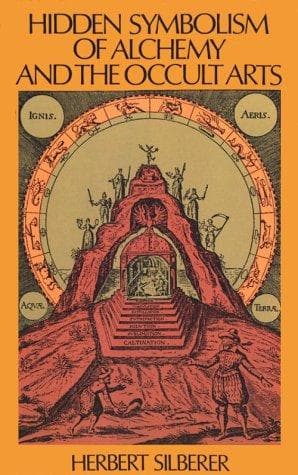
Hidden Symbolism of Alchemy and the Occult ArtsSilberer, Herbert
Religion
Hidden Symbolism of Alchemy and the Occult Arts
Silberer, Herbert
Alchemy; Society of Rosicrucians; Symbolism (Psychology)
For the purpose of being brought to life again the parts of the
dismembered animal are regularly put in a vessel or some container
(kettle, box, cloth, skin). In the case of the kettle, which corresponds
to the belly or uterus, they are generally cooked. Thus in the tale of the
juniper tree, the magic rejuvenations of Medea, which—except in the
version mentioning the magic potion—she practices on Jason and Æson, and
also on goats (cf. Thor and his goats). I must quote still other pertinent
observations of Rank (p. 313 ff). The motive of revivification, most
intimately connected with dismemberment, appears not only in a secondary
rôle to compensate for the killing, but represents as well simple coming
to life, i.e., birth. Rank believes that coming to life again applies
originally to a dissected snake (later other animals, chiefly birds), in
which we easily recognize the symbolical compensation for the phallus of
the Osiris story, excised and unfit for procreation, which can be brought
to life again by means of the water of life. “The idea that man himself at
procreation or at birth is assembled from separate parts, has found
expression not only in the typical widespread sexual theories of children,
but in countless stories (e.g., Balzac’s Contes drolatiques) and mythical
traditions. Of special interest to us is the antique expression
communicated by Mannhardt (Germ. Myth., p. 305), which says of a pregnant
woman that she has a belly full of bones,” which strikingly suggests the
feature emphasized in all traditions that the bones of the dismembered
person are thrown on a heap, or into a kettle (belly) or wrapped in a
cloth. [Even the dead Jesus, who is to live again, is enveloped in a
cloth. In several points he answers the requirements of the true
rejuvenation myth. The point is also made that the limbs that are being
put in the cloth must be intact, so that the resurrection may be properly
attained (as in a bird story where the dead bird’s bones must be carefully
preserved). The incompleteness (stigmata) also appears after the
resurrection.
John XIX, 33. “But when they came to Jesus, and saw that he was dead
already, they brake not his legs.”—40 f. “Then took they the body of Jesus
and wound it in linen cloths with the spices.... Now in the place where he
was crucified there was a garden, and in the garden a new sepulcher,
wherein was never man yet laid.”
We shall mention later the significance of garden and grave. It supports
that of the cloths.]
Rank considers that the circumstance that the dismembered person or animal
resurrected generally lacks a member, points without exception to
castration.
Public-domain text, read in full here on John Shaqi.
Reviews
Reviews
No reviews yet
Be the first to share your thoughts on this work.
Join the Discussion
Join the discussion
Sign in to leave a comment or review.
Sign InorCreate an account