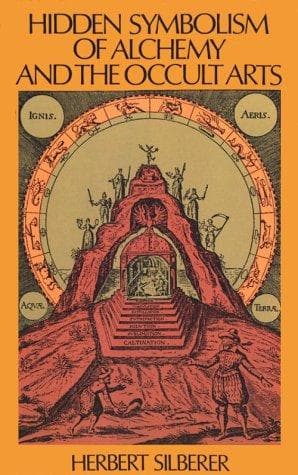
Hidden Symbolism of Alchemy and the Occult ArtsSilberer, Herbert
Religion
Hidden Symbolism of Alchemy and the Occult Arts
Silberer, Herbert
Alchemy; Society of Rosicrucians; Symbolism (Psychology)
In the Edda it is recounted “that Thor fared forth with his chariot and
his goats and with him the Ase, called Loki. They came at evening to a
peasant and found shelter with him. At night Thor took his goats and slew
them; thereupon they were skinned and put into a kettle. And when they
were boiled Thor sat down with his fellow travelers to supper. Thor
invited the peasant and his wife and two children to eat with him. The
peasant’s son was called Thialfi and the daughter Roskwa. Then Thor laid
the goats’ skins near the hearth and said that the peasant and his family
should throw the bones onto the skins. Thialfi, the peasant’s son, had the
thigh bone of one goat and cut it in two with his knife to get the marrow.
Thor stayed there that night, and in the morning he got up before dawn,
dressed, took the hammer, Miolner, and lifted it to consecrate the goats’
skins. Thereupon the goats stood up; but one of them was lame in the hind
leg. He noticed it and said that the peasant or some of his household must
have been careless with the goats’ bones, for he saw that a thigh bone was
broken.” We are especially to note here that the hammer is a phallic
symbol.
In fairy tales the dismemberments and revivifications occur frequently.
For example, in the tale of the Juniper Tree [Machandelboom] (Grimm, K. H.
M., No. 47), a young man is beheaded, dismembered, cooked and served up to
his father to be eaten. The father finds the dish exceptionally good. On
asking for his son he is answered that the youth has gone to visit
relatives. The father throws all the bones under the table. They are
collected by the sister, wrapped in a bit of cloth and laid under the
juniper tree. The soul of the boy soared in the air as a bird and was
afterward translated into a living youth. The Grimm brothers introduce as
a parallel: “The collection of the bones occurs in the myths of Osiris and
Orpheus, and in the legend of Adelbert; the revivification in many others,
e.g., in the tale of Brother Lustig (K. H. M., No. 81), of Fichter’s Vogel
(No. 46), in the old Danish song of the Maribo-Spring, in the German saga
of the drowned child, etc.” Moreover, W. Mannhardt (Germ. Mythen., pp.
57-75) has collected numerous sagas and fairy tales of this kind, in which
occur the revivifications of dismembered cattle, fish, goats, rams, birds,
and men.
The gruesome meal in the story of the juniper tree reminds us of the
Tantalus story and the meal of Thyestes. Demeter (or Thetes) ate a
shoulder of the dismembered Pelops, who was set before the gods by his
father Tantalus, and the shoulder, after he was brought to life again, was
replaced by an ivory one. In a story from the northeastern Caucasus, a
chamois similarly dismembered and brought to life, like Thor’s goats, gets
an artificial shoulder (of wood).
Public-domain text, read in full here on John Shaqi.
Reviews
Reviews
No reviews yet
Be the first to share your thoughts on this work.
Join the Discussion
Join the discussion
Sign in to leave a comment or review.
Sign InorCreate an account