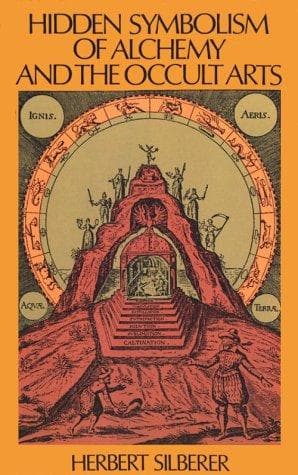
Hidden Symbolism of Alchemy and the Occult ArtsSilberer, Herbert
Religion
Hidden Symbolism of Alchemy and the Occult Arts
Silberer, Herbert
Alchemy; Society of Rosicrucians; Symbolism (Psychology)
the purpose of deepening the impression of improvement. Phantasies of
extraordinary abilities, special powers; contrasts to the anxiety of
examinations; all these in the case of the wanderer mark the change from
apprehension to fulfillment. We must not fail to recognize the element of
desire for honor; it will be yet described. In view of myth motives
reported by Stucken, the entire wall episode is to be conceived as a magic
flight; the people that fall off are the pursuers.
At the beginning of the ninth section of the parabola, the wanderer breaks
red and white roses from the rosebush and sticks them in his hat.
Red-white we already know as sexuality. The breaking off of flowers, etc.,
in dreams generally signifies masturbation; common speech also knows this
as “pulling off” or “jerking off.” In the symbolism of dreams and of myths
the hat is usually the phallus. This fact alone would be hardly worth
mentioning, but there are also other features that have a similar
significance. The fear of impotence points to autoerotic components in the
psychosexual constitution of the wanderer (of course not clearly
recognized as such), which is shown as well in the anxiety about ridicule
and disgrace that awaken ambition. This is clearest in the paragraphs 6,
10, 14, of the parable. That the masturbatory symbol precedes the
subsequent garden episode, can be understood if we realize that the
masturbation phantasy (which has an enormous psychic importance) animates
or predetermines the immediately following incest.
The wall about the garden that makes the long detour necessary (Sec. 9) is
as we know the resistance. Overcoming the resistance = going round the
wall, removal of the wall. Of course, after the completion of the detour
there is no wall. The wall, however, signifies also the inaccessibility or
virginity of the woman. The wall surrounds a garden. The garden is,
however (apart from the paradise symbolism derived from it), one of the
oldest and most indubitable symbols for the female body.
“Maiden shall I go with you
In your rose garden,
There where the roses stand
The delicate and the tender;
And a tree nearby
That moves its leaves,
And a cool spring
That lies just under it.”
Without much change the same symbolism is found in stately form in the
Melker Marienlied of the 12th century. (See Jung, Jb. ps. F., IV, S. 398
ff.)
Sainted Mary
Closed gate
Opened by God’s word—
Sealed fountain,
Barred garden,
Gate of Paradise.
Note also the garden, roses and fountains in the Song of Solomon.
The wanderer wishes to possess his mother as an unravished bride. Also a
feature familiar to psychoanalysis. The generally accompanying antithesis
is the phantasy that the mother is a loose woman = attainable, sexually
alluring woman. Perhaps this idea will also be found in the parable.
Public-domain text, read in full here on John Shaqi.
Reviews
Reviews
No reviews yet
Be the first to share your thoughts on this work.
Join the Discussion
Join the discussion
Sign in to leave a comment or review.
Sign InorCreate an account