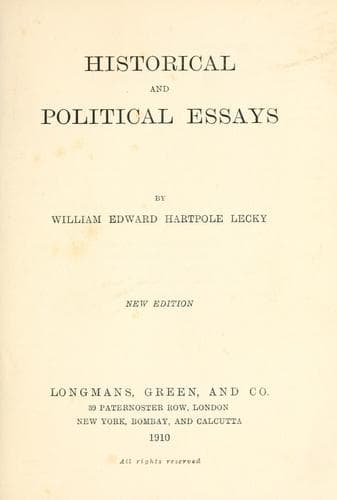
Historical and Political EssaysLecky, William Edward Hartpole
History
Historical and Political Essays
Lecky, William Edward Hartpole
History; Political science
legislature was disregarded.
Nearly seventy years of quiet followed. The establishment of the
Hanoverian dynasty, the Jacobite risings of 1715 and 1745, the
different wars in which England was engaged, left Ireland absolutely
undisturbed. The House of Commons then sat for a whole reign and met
only every second year. It was completely subservient to the English
Privy Council, and it consisted so largely of nomination boroughs that
a few great nobles commanded a decisive preponderance, and they
practically conducted the government and administered the patronage of
Ireland. There was great jobbing and corruption, but taxation, on the
whole, was exceedingly light, and there was no tendency to throw it
unduly on the poor, or to create in Ireland any of the many feudal
burdens that prevailed in France and Germany. The practical evil most
felt was the system of tithes for the support of the Protestant
establishment, and it was aggravated by a very unfair exemption of
pasture land, and also by the prevailing system of farming out tithes
to a class of men known as tithe proctors. In the country districts
all power was concentrated in the hands of the landlords, who, with
many faults and under many difficulties, at least succeeded in
attaining a large measure of genuine popularity.
There was an Irish army of twelve thousand men, but the greater part
of it was always sent abroad in time of war, and Ireland was then
often left with not more than five thousand soldiers. No militia and
no constabulary force existed, but when Whiteboy or other disturbances
arose, the landlords put themselves at the head of their tenantry, and
usually succeeded in suppressing them. Law was very little observed;
industrial virtues were at the lowest ebb; there was abundance of
drunkenness, idleness, turbulence, neglect of duty, extreme ignorance,
and extreme poverty; but there was not much real oppression or
religious bigotry, and there were no signs of political disturbance or
conspiracy. After a few years the portions of the penal code which
restricted the Catholic worship became a dead letter, and Catholic
chapels were everywhere rising on the Protestant estates. The
monopoly, however, of place and power continued, though the legal
profession was full of professing converts. The theological
temperature in both sects had greatly subsided. Land was usually let
by the owner on long leases, and at very low rents, to tenants who
almost invariably divided and sublet their tenancies.
Public-domain text, read in full here on John Shaqi.
Reviews
Reviews
No reviews yet
Be the first to share your thoughts on this work.
Join the Discussion
Join the discussion
Sign in to leave a comment or review.
Sign InorCreate an account