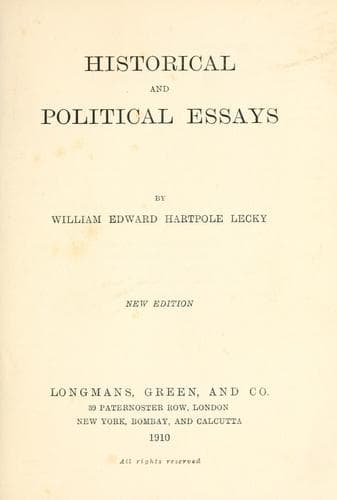
Historical and Political EssaysLecky, William Edward Hartpole
History
Historical and Political Essays
Lecky, William Edward Hartpole
History; Political science
There is much truth in these considerations, but it is also true that
the penal code produced more pernicious moral, social, and political
effects than many sanguinary persecutions. In other countries
disqualifying or persecuting laws were directed against small
fractions of the nation. In Ireland they were directed against the
bulk of the community. Being supported by little or no genuine
religious fanaticism or proselytising ardour, they made few
Protestants except in the upper orders, where many conformed in order
to keep their land or to enter professions; but they drove nearly all
the best and most energetic Catholics to the Continent; they
discouraged industry; closed the door of knowledge; taught the people
to look upon law as something hostile to religion; introduced
division and immorality into families by the rewards they offered to
apostasy; and condemned the whole country to poverty and impotence by
fatally depressing the great majority of its people. Under the
influence of the penal laws the Catholics inevitably acquired the
vices of serfs, and the Protestants the vices of monopolists. A great
portion of the code was pronounced, with good reason, to be flagrantly
opposed to the articles of the Treaty of Limerick, and it completed
the work of the confiscations by making the landlord class in Ireland
almost wholly Protestant, while the great majority of the tenantry
were Catholics.
There was a moment, however, in the beginning of the century when the
whole current of Irish history might easily have changed. Scotland had
suffered, like Ireland, from the protective policy that followed the
Revolution, and her independent Parliament had retaliated by measures
which threatened the speedy separation of the two crowns, and soon led
to a legislative Union. In Ireland such a Union was ardently desired
by enlightened Irishmen, and there is every reason to believe that it
could then have been carried with universal consent. The Catholics
were perfectly passive, and would gladly have accepted a change which
withdrew them from the direct government of the conquerors in a recent
civil war. The Protestants had as yet no distinctively national
feeling, and a legislative Union would have emancipated their industry
and added enormously to their security. Molyneux, the first great
champion of the legislative independence of Ireland, emphatically
declared that he and those who thought with him would gladly have
accepted the alternative of a Union, and both the Irish Houses of
Parliament voted addresses in favour of such a measure. If it had
been carried, Ireland would have been at least saved from the evils
that rose from the commercial restrictions and from the extreme
jobbing that grew up around the local legislature, and she would,
perhaps, have been saved from some parts of the penal code. But the
golden opportunity was lost. The English commercial classes dreaded
Irish competition in their markets, and the petition of the Irish
Public-domain text, read in full here on John Shaqi.
Reviews
Reviews
No reviews yet
Be the first to share your thoughts on this work.
Join the Discussion
Join the discussion
Sign in to leave a comment or review.
Sign InorCreate an account