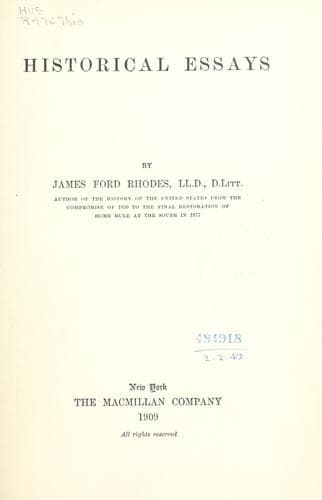
Great Britain -- History; History; United States -- History
sympathetic minds. "Tacitus," he wrote, "very frequently trusts to the
curiosity or reflection of his readers to supply those intermediate
circumstances and ideas, which, in his extreme conciseness, he has
thought proper to suppress."[72] How Gibbon would have filled those
gaps! Though he was seldom swayed by enthusiasm, his admiration of the
Roman historian fell little short of idolatry. His references in "The
Decline and Fall" are many, and some of them are here worth recalling to
mind. "In their primitive state of simplicity and independence," he
wrote, "the Germans were surveyed by the discerning eye and delineated
by the masterly pencil of Tacitus, the first of historians who applied
the science of philosophy to the study of facts."[73] Again he speaks of
him as "the philosophic historian whose writings will instruct the last
generation of mankind."[74] And in Chapter XVI he devoted five pages to
citation from, and comment on, Tacitus, and paid him one of the most
splendid tributes one historian ever paid another. "To collect, to
dispose, and to adorn a series of fourscore years in an immortal work,
every sentence of which is pregnant with the deepest observations and
the most lively images, was an undertaking sufficient to exercise the
genius of Tacitus himself during the greatest part of his life."[75] So
much for admiration. That, nevertheless, Gibbon could wield the critical
pen at the expense of the historian he rated so highly, is shown by a
marginal note in his own printed copy of "The Decline and Fall." It will
be remembered that Tacitus published his History and wrote his Annals
during the reign of Trajan, whom he undoubtedly respected and admired.
He referred to the reigns of Nerva and Trajan in suggested contrast to
that of Domitian as "times when men were blessed with the rare privilege
of thinking with freedom, and uttering what they thought."[76] It fell
to both Tacitus and Gibbon to speak of the testament of Augustus which,
after his death, was read in the Senate: and Tacitus wrote, Augustus
"added a recommendation to keep the empire within fixed limits," on
which he thus commented, "but whether from apprehension for its safety,
or jealousy of future rivals, is uncertain."[77] Gibbon thus criticised
this comment: "Why must rational advice be imputed to a base or foolish
motive? To what cause, error, malevolence, or flattery, shall I ascribe
the unworthy alternative? Was the historian dazzled by Trajan's
conquests?"[78]
Public-domain text, read in full here on John Shaqi.
Reviews
Reviews
No reviews yet
Be the first to share your thoughts on this work.
Elsewhere in the archive
Join the Discussion
Join the discussion
Sign in to leave a comment or review.
Sign InorCreate an account