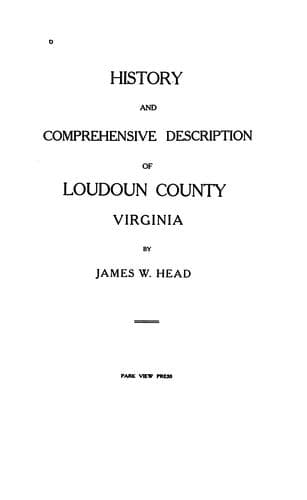
History and Comprehensive Description of Loudoun County, VirginiaHead, James William
History
History and Comprehensive Description of Loudoun County, Virginia
Head, James William
Loudoun County (Va.) -- History
The injurious plants with which the careful farmer must contend are
the wild garlic, tribby weed, dog fennel, two varieties of the common
daisy, oxeye daisy, St. John's wort, blue thistle, common thistle,
pigeon-weed, burdock, broad and narrow-leaved dock, poke-weed,
clot-bur, three-thorned bur, supposed to have been introduced from
Spain by the Merino sheep, Jamestown or "jimson" weed, sorrel, and, in
favorable seasons, a heavy growth of lambs quarter and rag-weed.
Of introduced grasses, Loudoun has red clover, timothy, herd's-grass,
orchard-grass, and Lucerne to which last little attention is now
given. Native grasses are the white clover, spear grass, blue grass,
fox-tail and crab grass, the two last-named being summer or annual
grasses. Several varieties of swamp or marsh grass flourish under
certain conditions, but soon disappear with proper drainage and
tillage.
Although some of the wild flowers of Loudoun merit the attention of
the florist, as a whole they have no commercial value or significance
and, for this reason, an enumeration of the many varieties has not
been thought expedient.
FAUNA.--Wild ducks, geese, and turkeys, pheasants (English
and Mongolian), partridges and woodcock are among the game fowls of
Loudoun, and eagles, crows, buzzards, owls, and hawks among the
predatory. The usual list of songbirds frequent this region in great
numbers and receive some protection under the stringent fish and game
laws in force here.
Red and gray foxes, raccoons, opossums, woodchucks, squirrels, hares
and smaller animals are quite general.
In pioneer days the county abounded in the larger species of game
common to the forests of North America. Among these were the beaver
and otter, buffalo, deer, wolf, wild-cat, panther, bear, fox, and elk
or wapiti (_Cervus canadensis_), noble herds of which ranged the
mountain sides and valleys of this section.
TRANSPORTATION FACILITIES.[13]
Good roads, always of immeasurable importance to the farmer, were
early made necessary by the tremendous crops of marketable products
harvested from Loudoun lands. Though this need, in time, became
imperative the roads were never hastily and imperfectly constructed;
they were built with an eye single to permanence and with due
allowance for generations of unintermittent and augmentative traffic.
These roads yielded their promoters modest dividends, but with the
completion in 1832 of the Chesapeake and Ohio Canal, bordering the
county just across the Potomac, transportation to and from Washington
(Georgetown) and Alexandria was materially cheapened and the earnings
of the turnpike companies suffered a corresponding decrease, the
income, in many cases, being barely sufficient to defray the expense
of maintenance. Tolls are now collected at only two points, in the
County.
Public-domain text, read in full here on John Shaqi.
Reviews
Reviews
No reviews yet
Be the first to share your thoughts on this work.
Join the Discussion
Join the discussion
Sign in to leave a comment or review.
Sign InorCreate an account