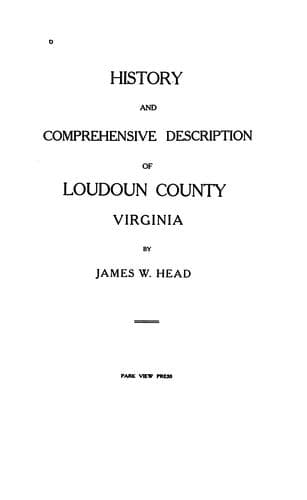
History and Comprehensive Description of Loudoun County, VirginiaHead, James William
History
History and Comprehensive Description of Loudoun County, Virginia
Head, James William
Loudoun County (Va.) -- History
Of this number, 207 square miles lie east of Catoctin Mountain and are
of the upper secondary formation, while the remaining 318 square miles
to the westward are of primitive formation.
The longest line across the County is 35 miles, and extends from the
lower end of Lowe's Island at the old mouth of Sugarland Run, to the
summit of the Blue Ridge at Ashby's Gap; the second longest, 34 miles,
extends from the corner of Jefferson County, West Virginia, at the
margin of the Potomac River below Harpers Ferry, to the corner of
Fairfax County on Bull Run, within half a mile of Sudley Springs in
Prince William County.
Within the limits of Loudoun are included 313,902[16] acres of the
finest farm land to be found in any county of the State. The farms
number 1,948, the average size being 162 acres. They are smallest in
the northwestern portion of the county and of moderate size in the
central portions, the largest occurring in the southern and eastern
portions. In 1900, 1,754, or 90 per cent, were operated by white
farmers, and 194, or 10 per cent, operated by colored farmers.
[Footnote 16: It will be understood that the total land in farms by no
means equals the total area of the County.]
TABLE I.--_Summary by Decades of the Improved and Unimproved
Land in Farms, with per cent of Increase and Decrease._
-------+-----------------------------------+---------------------------------
| Acres of Land in Farms. | Per cent of Increase.
|---------+-----------+-------------+---------+----------+------------
Census | | | | Total | Improved | Unimproved
Year. | Total. | Improved. | Unimproved. | Land. | Land. | Land.
-------+---------+-----------+-------------+---------+----------+------------
1900 | 313,902 | 251,874 | 62,028 | 6.4 | 6.9 | 4.8
1890 | 294,896 | 235,703 | 59,193 | [*]1.3 | 1.4 | [*]11.
1880 | 298,869 | 232,391 | 66,478 | 8.2 | 15.1 | [*]10.7
1870 | 276,291 | 201,888 | 74,403 | [*]6.7 | [*]8.3 | [*] 1.9
1860 | 296,142 | 220,266 | 75,876 | .5 | 5.7 | [*] 1.2
1850 | 294,675 | 208,454 | 86,221 | - | - | -
-------+---------+-----------+-------------+---------+----------+------------
[* - Decrease.]
The most striking fact to be noted concerning the reported farm areas
is the comparatively great decrease in the decade 1860 to 1870. This
was, of course, one of the disastrous effects of the Civil War, from
which the South, in general, after more than forty-five years, has not
yet fully recovered, as is shown by the fact that in some of the South
Atlantic states the reported acreage of farm land in 1900 was less
than it was in 1860.
Public-domain text, read in full here on John Shaqi.
Reviews
Reviews
No reviews yet
Be the first to share your thoughts on this work.
Elsewhere in the archive
Join the Discussion
Join the discussion
Sign in to leave a comment or review.
Sign InorCreate an account