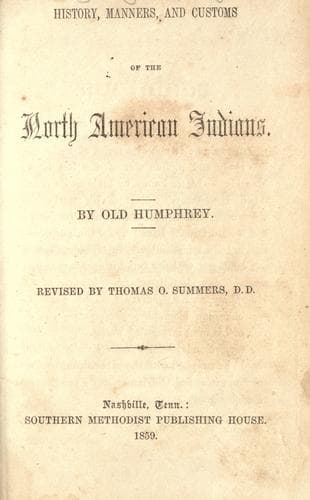
History, Manners, and Customs of the North American IndiansOld Humphrey
History
History, Manners, and Customs of the North American Indians
Old Humphrey
Indians of North America
_Hunter._ While they were sitting down to partake of some wild turkey
and deer, with which their bows and arrows had furnished them during
their flight, their enemies again fell upon them. The Seminoles had,
perhaps, altogether two thousand warriors, with Oseola at their head;
but then the whites had at least ten thousand, to say nothing of their
being much better armed. No wonder that the Seminoles were compelled
to fly, and only to fight when they found a favourable opportunity.
But I must not dwell longer than necessary on my account; suffice it
to say, that, after all the bravery of the warriors, and all the
exertions of Econchatti, Nikkanochee once more fell into the hands of
the enemy.
_Basil._ Oh, that was terrible! I hoped he would get away safe.
_Brian._ So did I. I thought the white men would be tired of following
them into those dreary forests and muddy swamps.
_Austin._ How was it that Nikkanochee was taken?
_Hunter._ He was captured on the 25th of August, 1836, by some
soldiers who were scouring the country, and brought by them the next
day to Colonel Warren. Poor little fellow, he was so worn, emaciated
and cast down, that he could not be looked upon without pity. For
several weeks he hardly spoke a word. No tear, no sob, nor sigh
escaped him; but he appeared to be continually on the watch to make
his escape. The soldiers who had taken him prisoner declared that they
had followed his track full forty miles before they came up to him.
From the rising to the setting of the sun they hurried on, and still
he was before them. Nikkanochee must then have been only about five or
six years old.
_Basil._ Why, I could not walk so far as forty miles to save my life.
How did he manage it?
_Hunter._ You have not been brought up like an Indian. Fatigue and
hardship and danger are endured by red men from their earliest
infancy. The back to the burden, Basil. You have heard the saying,
"God tempers the wind to the shorn lamb." When the soldiers came up to
Nikkanochee, he darted into the bushes and long grass, where they
found him. At first, he uttered a scream; but, soon after, he offered
the soldiers a peach which he had in his hand, that they might let him
go. Placed on horseback behind one of the troopers, he was brought to
the military station.
_Brian._ They have him now, then, fast enough. I wonder what became of
Econchatti-mico, his father.
_Hunter._ That is not known. I should have told you that, in the
Seminole language, "Econ," means hill or hills; "Chatti," is red; and
the signification of "mico," is king: so that Econchatti-mico is, all
together, King of the Red Hills. The soldiers who captured Nikkanochee
disputed among themselves whether he ought not to be killed. Most of
them were for destroying every Indian man, woman, or child they met;
but one of them, named James Shields, was determined to save the boy's
life, and it was owing to his humanity that Nikkanochee was not put to
death.
Public-domain text, read in full here on John Shaqi.
Reviews
Reviews
No reviews yet
Be the first to share your thoughts on this work.
Join the Discussion
Join the discussion
Sign in to leave a comment or review.
Sign InorCreate an account