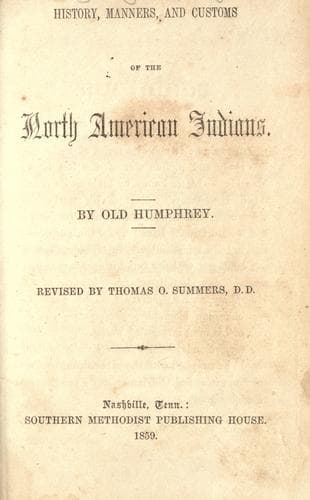
History, Manners, and Customs of the North American IndiansOld Humphrey
History
History, Manners, and Customs of the North American Indians
Old Humphrey
Indians of North America
_Hunter._ It is; but the young Indian has already gained the good will
of his intended wife: not by his fine clothes and his wealth, for he
has neither the one nor the other, but by showing her the skins of the
bears he has killed, and the scalps and scalp-locks of the foes he has
slaughtered; and by telling her that he will hunt for her, that she
may be kept from want, and fight for her, that she may be protected
from the enemies of her tribe. Indians have strange customs: some
flatten the heads of their young children, by laying them in a cradle,
with a pillow for the back of the head, and then pressing the
forehead, day after day, with a board, that comes down upon it, till
the nose and forehead form a straight line.
_Brian._ I should not like my head to be flattened in that manner.
_Hunter._ Children are carried about in their cradles on the backs of
their mothers, wherever they go; and when children die, they are often
left, in their cradles, floating on the water of a brook or pool,
which their superstition teaches them to regard as sacred. A cluster
of these little arks or cradles, or coffins as they may be called, of
different forms, in a lone pool, is a very picturesque and affecting
sight.
_Basil._ I shall often think of the pool, and the little cradles
swimming on it. It would remind me of Moses in the bulrushes.
_Hunter._ There are other singular customs among the Indians. The
Kowyas, the Pawnees, the Sacs and Foxes, the Osages, and the Iowas,
all shave their heads, leaving a tuft on the crown two or three inches
in length, and a small lock in the middle of it, as long as they can
make it grow. By means of this small lock of hair braided, they
ornament the tuft with a crest of the deer's tail dyed scarlet, and
sometimes add to it a war-eagle's feather.
_Austin._ How different from the Crow Indians! They do not shave off
their hair; but let it grow till it hangs down to the very ground.
_Hunter._ You have not forgotten that, I see. There is a cruel custom
among the Indians, of exposing their aged people, that is, leaving
them alone to die. If a party are obliged to remove from one place to
another in search of food, and there is among them an aged man, who
can no longer fight, nor hunt, nor fish, nor do any thing to support
himself, he is liable, although in his time he may have been a
war-chief, to be left alone to die. I have seen such a one sitting by
a little fire left him by his tribe, with perhaps a buffalo skin
stretched on poles over his head, and a little water and a few bones
within his reach. I have put my pipe to his mouth, given him pemican,
and gathered sticks, that he might be able to recruit his fire; and
when, months after, I have returned to the spot, there has been
nothing left of him but his skeleton, picked clean by the wolves and
bleaching in the winds.
_Austin._ This is one of the worst things we have heard of the
Indians.
_Basil._ Oh, it is very sad indeed!
Public-domain text, read in full here on John Shaqi.
Reviews
Reviews
No reviews yet
Be the first to share your thoughts on this work.
Elsewhere in the archive
Join the Discussion
Join the discussion
Sign in to leave a comment or review.
Sign InorCreate an account