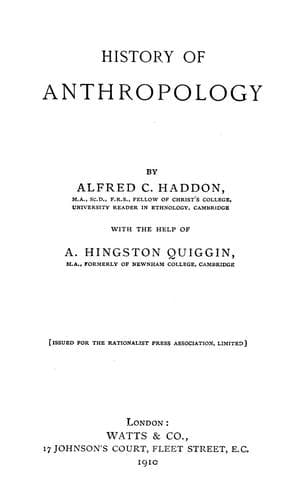
History of anthropologyHaddon, Alfred C. (Alfred Cort)
History
History of anthropology
Haddon, Alfred C. (Alfred Cort)
Anthropology -- History
The terms Magdalenian, Solutrian, Aurignacian, Mousterian, Acheulian,
Chellian, refer to various epochs of culture in Palæolithic times,
giving their sequence from the newest to the most ancient. These
epochs are further sub-divided by some investigators, and several, if
not all of them, are connected by intermediate stages. In other words,
the remains prove that a steady evolution in culture has taken place.
Nowhere do all these layers occur in one locality, and the evidence of
their order is a matter of stratigraphy (_i.e._, it is essentially a
geological method). Palæontology decides on the animal remains found
in the beds. The human anatomist discusses the human remains, and the
archæologist deals with the artifacts or objects made by man. The
accurate determination of the order of the beds is obviously of
fundamental importance.
The discovery of these human remains has had a very noticeable effect on
anthropometry. Most of them are imperfect, some very much so; as in the
case, for example, of the partial calvaria of Pithecanthropus and of the
Neanderthal specimen. The remains are of such intense interest that they
stimulated anatomists to a more careful analysis and comparison with
other human skulls and with those of anthropoids. As time rolled on, new
ways of looking at the problems suggested themselves, which led to the
employment of more elaborate methods of measurement or description.
Almost every specimen of fossil man has led to some improvement in
technical research; and the subject is not yet exhausted, as the
character of the inner walls of the crania have not yet yielded all
their secrets, more particularly in regard to the brains which they once
protected. It would be tedious to enumerate the names of those who have
studied even the two calvaria just mentioned, and impossible to record
all of those who have advanced our knowledge of the anatomy of fossil
man.
------------------------------------------------------------------------
CHAPTER V.
COMPARATIVE PSYCHOLOGY
AT the present time the data for a comparison of the bodily functions of
the members of one race with those of another are so scanty that the
science of ethnical physiology can scarcely be said to exist.
Fortunately, there is a quite different state of affairs for the study
of the mind—or Psychology—though even in this field there is yet a great
deal of work to be done.
During the eighteenth century the term “Anthropology,” which was very
vaguely employed, was often used to designate a comprehensive psychology
dealing with the entire mental side of man, as well as the relations
between soul and body. Later, as its scope became widened, the centre of
gravity shifted over to physical man; but anthropologists have always
maintained their right to deal also more or less with psychology.
[Sidenote: =Phrenology.=]
Public-domain text, read in full here on John Shaqi.
Reviews
Reviews
No reviews yet
Be the first to share your thoughts on this work.
Join the Discussion
Join the discussion
Sign in to leave a comment or review.
Sign InorCreate an account