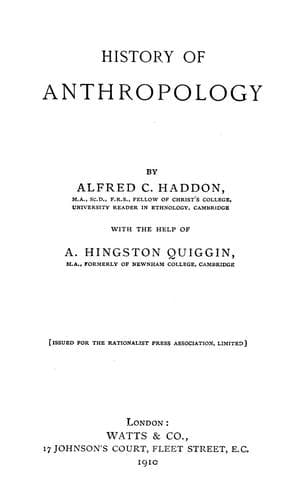
History of anthropologyHaddon, Alfred C. (Alfred Cort)
History
History of anthropology
Haddon, Alfred C. (Alfred Cort)
Anthropology -- History
Psychology in early times concerned itself with the essence of the soul
as an independent entity, its relations to the body, its destructibility
or indestructibility, and the laws of its operations. The word
“Psychology” has always had a vague and varying significance. Thus, when
Hunt, in his presidential address before the Anthropological Society in
1866, says: “I am glad to know that there are many Fellows of this
Society who are at present working on the psychological aspects of our
science,” he referred to the interest then taken by the members in the
phrenology of the period. Later on, however, he expresses his opinion
with regard to “modern phrenology” as being “wholly unscientific.” The
old phrenology is now practically dead.
[Sidenote: =Psychical Research.=]
During the last quarter of the last century a study of various obscure
mental states received a fresh impetus in this country by the founding
of the Society for Psychical Research. This society principally
investigates (1) hypnotism, disorders of personality, automatic writing,
and crystal-gazing, which are universally recognised by psychologists as
furnishing fields for scientific study; and (2) thought-transference and
its manifestations, which are not, however, at present generally
accepted as facts.
Though but recently crept forth, _vix aut ne vix quidem_, from
the chill shade of scientific disdain, Anthropology adopts the
airs of her elder sisters among the sciences, and is as severe
as they to the Cinderella of the family, Psychical Research. She
must murmur of her fairies among the cinders of the hearth,
while they go forth to the ball, and dance with provincial
mayors at the festivities of the British Association.[59]
Footnote 59:
A. Lang, _Making of Religion_, p. 43.
The hypnotic and kindred practices of the lower races have until lately
scarcely attracted the attention of anthropologists. Bastian in 1890
wrote a tract, _Ueber psychische Beobachtungen bei Naturvölkern_, and
Tylor has also touched on the subject in _Primitive Culture_; but its
main advocate is Andrew Lang, who declares: “Anthropology must remain
incomplete while it neglects this field, whether among wild or civilised
men,” and “In the course of time this will come to be acknowledged.”
[Sidenote: =Methods and Aims.=]
If we turn now from popular to scientific notions of psychology, we
discern the following methods and aims of the science. There are two
methods—(1) the introspective, by which one’s own mental states are
observed; and (2) the objective, by which the conduct of others is
observed: both may be studied without or under experimental conditions.
It is very difficult to secure reliable introspection in backward
peoples, and also to interpret the mental state of an individual by
observing his behaviour.
The objects of psychology are five-fold:—
1. The study of mind compared with non-mental processes.
Public-domain text, read in full here on John Shaqi.
Reviews
Reviews
No reviews yet
Be the first to share your thoughts on this work.
Join the Discussion
Join the discussion
Sign in to leave a comment or review.
Sign InorCreate an account