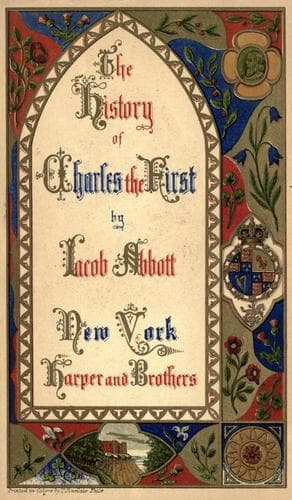
History of King Charles the First of EnglandAbbott, Jacob
History
History of King Charles the First of England
Abbott, Jacob
Charles I, King of England, 1600-1649; Great Britain -- History -- Charles I, 1625-1649; Great Britain -- Kings and rulers -- Biography
Things went on so for four or five years, the breach between the king
and the people growing wider and wider. Within this time there were
four Parliaments called, and, after various contentions with them,
they were, one after another, dissolved. The original subject of
disagreement, viz., the growing influence of the Catholics, was not the
only one. Other points came up, growing out of the king's use of his
prerogative, and his irregular and, as they thought, illegal attempts
to interfere with their freedom of action. The king, or, rather,
Buckingham using the king's name, resorted to all sorts of contrivances
to accomplish this object. For instance, it had long been the custom,
in case any member of the House of Peers was absent, for him to give
authority to any friend of his, who was also a member, to vote for
him. This authority was called a _proxy_. This word is supposed to be
derived from _procuracy_, which means action in the place of, and in
behalf of, another. Buckingham induced a great number of the peers to
give him their proxies. He did this by rewards, honors, and various
other influences, and he found so many willing to yield to these
inducements, that at one time he had thirty or forty proxies in his
hands. Thus, on a question arising in the House of Lords, he could give
a very large majority of votes. The House, after murmuring for some
time, and expressing much discontent and vexation at this state of
things, finally made a law that no member of the House should ever have
power to use more than _two_ proxies.
[Sidenote: Impeachment of Buckingham.]
[Sidenote: The king interferes.]
One of the Parliaments which King Charles assembled at length brought
articles of impeachment against Buckingham, and a long contest arose
on this subject. An impeachment is a trial of a high officer of state
for maladministration of his office. All sorts of charges were brought
against Buckingham, most of which were true. The king considered
their interfering to call one of his ministers to account as wholly
intolerable. He sent them orders to dismiss that subject from their
deliberations, and to proceed immediately with their work of laying
taxes to raise money, or he would dissolve the Parliament as he had
done before. He reminded them that the Parliaments were entirely "in
his power for their calling, sitting, and dissolution, and as he
found their fruits were for good or evil, so they were to continue,
or not to be." If they would mend their errors and do their duty,
henceforward he would forgive the past; otherwise they were to expect
his irreconcilable hostility.
[Sidenote: Another dissolution.]
Public-domain text, read in full here on John Shaqi.
Reviews
Reviews
No reviews yet
Be the first to share your thoughts on this work.
Join the Discussion
Join the discussion
Sign in to leave a comment or review.
Sign InorCreate an account