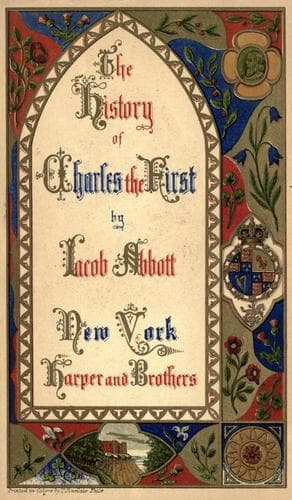
History of King Charles the First of EnglandAbbott, Jacob
History
History of King Charles the First of England
Abbott, Jacob
Charles I, King of England, 1600-1649; Great Britain -- History -- Charles I, 1625-1649; Great Britain -- Kings and rulers -- Biography
The king's government gained the victory, ostensibly, in this contest,
and Hampden had to pay his money. Very large sums were collected,
also, from others by this tax, and a great fleet was raised. The
performances and exploits of the fleet had some influence in quieting
the murmurs of the people. The fleet was the greatest which England had
ever possessed. One of its exploits was to compel the Dutch to pay a
large sum for the privilege of fishing in the narrow seas about Great
Britain. The Dutch had always maintained that these seas were public,
and open to all the world; and they had a vast number of fishing boats,
called herring-busses, that used to resort to them for the purpose
of catching herring, which they made a business of preserving and
sending all over the world. The English ships attacked these fleets of
herring-busses, and drove them off; and as the Dutch were not strong
enough to defend them, they agreed to pay a large sum annually, for the
right to fish in the seas in question, protesting, however, against it
as an extortion, for they maintained that the English had no control
over any seas beyond the bays and estuaries of their own shores.
One of the chief means which Charles depended upon during the long
period that he governed without a Parliament, was a certain famous
tribunal or court called the _Star Chamber_. This court was a very
ancient one, having been established in some of the earliest reigns;
but it never attracted any special attention until the time of Charles.
His government called it into action a great deal, and extended its
powers, and made it a means of great injustice and oppression, as
the people thought, or, as Charles would have said, a very efficient
means of vindicating his prerogative, and punishing the stubborn and
rebellious.
[Sidenote: Court of the Star Chamber.]
[Sidenote: Its constitution.]
There were three reasons why this court was a more convenient and
powerful instrument in the hands of the king and his council than any
of the other courts in the kingdom. First, it was, by its ancient
constitution, composed of members of the _council_, with the exception
of two persons, who were to be judges in the other courts. This plan of
having two judges from the common law courts seems to have been adopted
for the purpose of securing some sort of conformity of the Star Chamber
decisions with the ordinary principles of English jurisprudence. But
then, as these two law judges would always be selected with reference
to their disposition to carry out the king's plans, and as the other
members of the court were all members of the government itself, of
course the court was almost entirely under governmental control.
[Sidenote: Trial by jury.]
[Sidenote: No jury in the Star Chamber.]
Public-domain text, read in full here on John Shaqi.
Reviews
Reviews
No reviews yet
Be the first to share your thoughts on this work.
Elsewhere in the archive
Join the Discussion
Join the discussion
Sign in to leave a comment or review.
Sign InorCreate an account