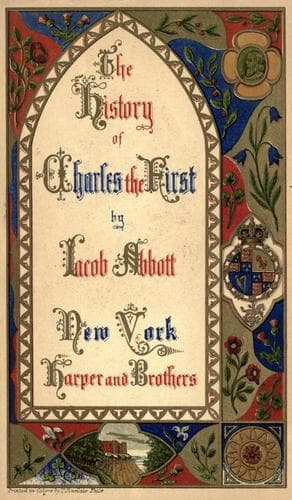
History of King Charles the First of EnglandAbbott, Jacob
History
History of King Charles the First of England
Abbott, Jacob
Charles I, King of England, 1600-1649; Great Britain -- History -- Charles I, 1625-1649; Great Britain -- Kings and rulers -- Biography
There has been a great deal of discussion about the origin of the
term Star Chamber. The hall where the court was held was in a palace
at Westminster, and there were a great many windows in it. Some think
that it was from this that the court received its name. Others suppose
it was because the court had cognizance of a certain crime, the Latin
name of which has a close affinity with the word star. Another reason
is, that certain documents, called _starra_, used to be kept in the
hall. The prettiest idea is a sort of tradition that the ceiling of
the hall was formerly ornamented with stars, and that this circumstance
gave name to the hall. This supposition, however, unfortunately, has
no better foundation than the others; for there were no stars on the
ceiling in Charles's time, and there had not been any for a hundred
years; nor is there any positive evidence that there ever were.
However, in the absence of any real reason for preferring one of
these ideas over the other, mankind seem to have wisely determined on
choosing the prettiest of them, so that it is generally agreed that the
origin of the name was the ancient decoration of the ceiling of the
hall with gilded stars.
[Sidenote: Immense power of the Court of Star Chamber.]
[Sidenote: Oppressive fines.]
However this may be, the court of the Star Chamber was an engine of
prodigious power in the hands of Charles's government. It helped them
in two ways. They could punish their enemies, and where these enemies
were wealthy, they could fill up the treasury of the government by
imposing enormous fines upon them. Sometimes the offenses for which
these fines were imposed were not of a nature to deserve such severe
penalties. For instance, there was a law against turning tillage
land into pasturage. Land that is tilled supports men. Land that
is pastured supports cattle and sheep. The former were a burden,
sometimes, to landlords, the latter a means of wealth. Hence there
was then, as there is now, a tendency in England, in certain parts
of the country, for the landed proprietors to change their tillage
land to pasture, and thus drive the peasants away from their homes.
There were laws against this, but a great many persons had done it
notwithstanding. One of these persons was fined four thousand pounds;
an enormous sum. The rest were alarmed, and made _compositions_, as
they were called; that is, they paid at once a certain sum on condition
of not being prosecuted. Thirty thousand pounds were collected in this
way, which was then a very large amount.
[Sidenote: King's forests.]
Public-domain text, read in full here on John Shaqi.
Reviews
Reviews
No reviews yet
Be the first to share your thoughts on this work.
Elsewhere in the archive
Join the Discussion
Join the discussion
Sign in to leave a comment or review.
Sign InorCreate an account