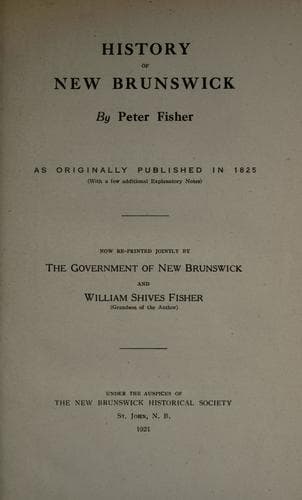
New Brunswick -- Description and travel; New Brunswick -- History
This is a good county for stock, having a number of fine Islands within
its limits. The inhabitants are principally agriculturalists who have
well improved farms and good stocks of cattle. The land is of an
excellent quality and in general well cultivated. The soil along the
bank of the river in the Parish of Waterborough is equalled by none in
the Province for fertility. As the country descends to the Jemseg, the
rich sediment deposited by the annual overflowing of the river,
produces the most luxuriant vegetation, and although the farmer can
seldom commence his labours till June, yet so productive is the soil,
that in a few weeks the county exhibits the most exuberant vegetation.
Indian corn flourishes in this Parish in the highest perfection: the
soil being a light rich loam and the country level so as to receive the
full effect of the sun. Small grain, grass, and roots are also produced
here in the greatest abundance. Indeed a more fertile district can
scarcely be conceived than the land from Maugerville to the Jemseg. The
observations that were made about the road through Maugerville and
Sheffield mill likewise apply here, very little attention having of
late been paid to them, and it is probable that the statute labor is
but seldom fully performed in any of those Parishes. There is a
convenient Chapel belonging to the Baptists in Waterborough, which has
a stated minister and numerous congregation.--After crossing the
Jemseg, the country rises, and the Parish of Wickham exhibits some well
improved farms in pleasant and sightly situations. The Grand Lake, the
largest body of inland water in the Province, lies back of
Waterborough. It is nearly thirty miles long, and from three to nine
wide. A large stream called Salmon River, falls into it near the head.
This stream is well timbered with pine. A short portage leads from this
stream to the waters communicating with the river Miramichi. This lake
discharges its waters into the Saint John, by a narrow gut called
Jemseg, which is about thirty rods wide and very deep. The country on
the Western side of this lake is in many places low and marshy, having
the French and Maquapit lakes in its neighborhood which are settled in
places. The country in the vicinity of the Grand Lake abounds with
coal, which is found of a good quality, particularly at a creek called
New-Castle, where large quantities have been dug. A stratum is
generally found near the surface of the earth: the first layer of coal
being about eighteen inches in depth, and they are found to improve in
quality in proportion to the depth of the veins. The layers are nearly
horizontal, and are probably a continuation of the strata found at Cape
Breton, which has been ascertained to proceed in a Southwestern
direction from that island, to Nova-Scotia and New-Brunswick. The Grand
Lake is well settled, and has a resident Minister belonging to the
Established Church. It has likewise a Methodist Chapel; but no stated
Public-domain text, read in full here on John Shaqi.
Reviews
Reviews
No reviews yet
Be the first to share your thoughts on this work.
Join the Discussion
Join the discussion
Sign in to leave a comment or review.
Sign InorCreate an account