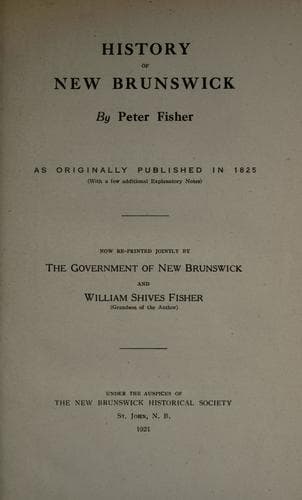
New Brunswick -- Description and travel; New Brunswick -- History
The Parish of Portland contains old Fort Howe. This Fort is situated on
a rugged hill at the mouth of the river Saint John, and completely
commands the harbour. Portland is well built up, but the road near the
Fort is very narrow, and in a wretched state, considering that it is
the only thoroughfare from the city, to the Indian House, so called;
which is situated in front of the bay, just above the falls, and where
vessels and boats come too, going and coming to wait for the tide, and
where passengers from all parts of the river land, and frequently walk
over the tongue of land to Saint John, which is a little more than a
mile. Passengers likewise going up the river in the Steam-Boat or
Sloops, usually ride or walk from Saint John to the Indian House, and
baggage and goods of all descriptions, are transported above the falls
by this route, which keeps the road continually thronged, and points
out the necessity of having a good and safe communication in such a
public place. There is no public place of worship in Portland of any
denomination: the inhabitants resort to the different places of worship
in the city.
The settlements of Quaco, Manawagonish, Musquash, &c. are in a
flourishing state. Considerable progress has been made in Agriculture,
and there is reason to believe the country round the Bay shore is rich
in minerals. Manganese has been found at Quaco, and the adjoining
district, which has been sent to the United States, and is said to be
of a good quality.
SECTION VI.
Having in the preceding sections briefly described the five Counties
lying along the river St. John; I shall now proceed with the three
remaining, commencing with
CHARLOTTE.
This County is bounded by the Bay of Fundy on the south, by the St.
Croix river, and the Bay of Passamaquoddy on the west and south west,
on the east by a north line from Point Lepreau, and on the north by a
west line commencing in the said north line thirty-three miles from
Point Lepreau, and contains nine thousand two hundred and sixty-seven
inhabitants.
It is divided from the United States by the river St. Croix, commonly
called the Schoodick, which is the line in this quarter that divides
the territories of His Britannic Majesty from the District (State) of
Maine. It comprehends several large Islands in the Bay of
Passamaquoddy, and is divided into the following Parishes:--St.
Andrews, St. Stephens, St. Davids, St. Patricks, St. Georges,
Pennfield, Campobello, West Isles, and Grand Manan.
The Parish of St. Andrews, besides the town of that name already
described, possesses many advantages for trade, being situated very
conveniently for navigation. It has several Saw-Mills, and a great
quantity of boards, planks, &c. are shipped from that port.
Public-domain text, read in full here on John Shaqi.
Reviews
Reviews
No reviews yet
Be the first to share your thoughts on this work.
Elsewhere in the archive
Join the Discussion
Join the discussion
Sign in to leave a comment or review.
Sign InorCreate an account