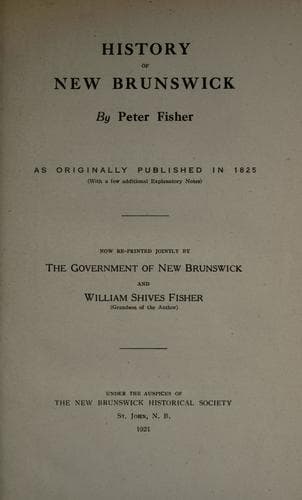
New Brunswick -- Description and travel; New Brunswick -- History
Is bounded eastwardly by the line of Nova-Scotia, and the Gulph of St.
Lawrence; northerly, by a west line running into the country from the
northernmost point of Shediac Island; westwardly, by a line beginning
at a point in the north boundary of St. John County; north, from Quaco
head, and running north till it meets said west line; southerly, by St.
John County and Chignecto. It contains nine thousand three hundred and
three inhabitants.
This County is situated at the head of the Bay of Fundy, and joins
Nova-Scotia. The line between the Provinces is the narrowest part of
the isthmus between the Bay of Fundy and Bay Verte. A small stream over
which there is a bridge--forming the separating line. It contains the
following Parishes:--Westmorland, Sackville, Hillsborough, Hopewell,
Moncton, Dorchester, Salisbury, and Botsford.
A considerable part of this county was formerly settled by the Acadians
or French neutrals, whose descendants are still numerous in this and
the adjoining County of Northumberland, being spread along the
seaboard, to the Bay of Chaleur. They have settlements at Memramcook,
Peticodiac, Bay Verte, Cocagne, Bucktouche, Richibucto, &c.--where
there are several large Chapels, which are usually supplied with Romish
Missionaries, who are supported by tythes from the French Catholics.
But the most thriving class of settlers are the English, chiefly from
Yorkshire, or their descendants. They are in general good farmers and
attend chiefly to husbandry. Indian corn is but little cultivated in
this county, the climate being too cool and temperate for that plant to
thrive well; but wheat, oats, potatoes, &c. flourish here in great
perfection. This is the finest part of the Province for stock; from the
extensive tracts of salt marsh which lie in this county, many thousand
acres of which are dyked and produce abundant crops. Butter and cheese
are made and exported from this county in large quantities. The cattle
are superior to any in the country from the great attention that has
been paid by the inhabitants to crossing and improving the breed.
During the American war nine hundred head of cattle, and eight hundred
firkins of butter, were sent from this county to Halifax, and other
places in one year, and although the demand has fallen off since the
peace, there are still large droves taken from Cumberland to Halifax,
and St. John--and likewise large quantities of butter and cheese.
Public-domain text, read in full here on John Shaqi.
Reviews
Reviews
No reviews yet
Be the first to share your thoughts on this work.
Elsewhere in the archive
Join the Discussion
Join the discussion
Sign in to leave a comment or review.
Sign InorCreate an account