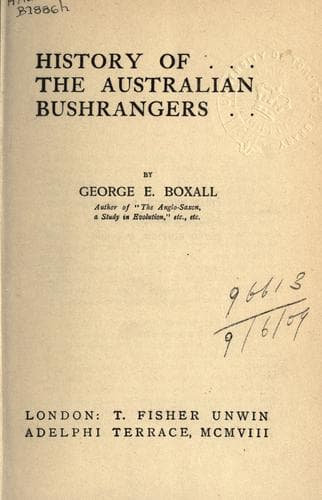
History of the Australian BushrangersBoxall, George
History
History of the Australian Bushrangers
Boxall, George
Bushrangers -- Australia
The trial of Mathew Brady excited great interest. He and his gang
had kept the country in a ferment for twenty-two months. Many of his
companions had been shot or captured, but the leader had escaped.
One of his mates, James Crawford, who had escaped with him from
Macquarie Harbour, but who had been shot by the soldiers some time
before the break up of the gang, was said to have been a lieutenant in
the army.[30] Numerous stories were told to illustrate his reckless
bravery, his skill in strategy, or some other trait of his character.
On the day of his trial a number of ladies were in the court, and when
the verdict of guilty was returned, and the judge put on the black cap,
they showed their sympathy by weeping so loudly that the judge had to
pause until order was restored, and sentence of death was pronounced
amid signs of sorrow by all present.[31]
At the same sessions Jefferies, Hopkins, Bryant, Tilly, McKenny, Brown,
Gregory, Hodgetts, and Perry were sentenced to death for bushranging,
cattle, horse, and sheep stealing, and for murder. Some of these had
been "in the bush" with Brady. The last of the batch was hung on
April 29th, 1826, the prisoners being hung two or three at a time at
intervals of a few days.
The remnant of the gang under the command of Dunne continued for a time
to commit depredations. In one of their journeys they saw a tribe of
blacks camped on the other side of the river. Dunne swam across and
attacked them. He fought them for some time driving them back until he
seized one of the women, when he turned back forcing her to accompany
him across the river. He had this black girl with him when an attack
was made on Mr. Thomson's house, but she escaped. On the following day
two men were quietly driving in a cart along the road when the blacks
attacked and speared them, killing one and wounding the other. The
blacks went on and burned the hut of Mr. Nicholas. They attacked Mr.
Thomson's place, and speared a man named Scott. The woman who had been
stolen by Dunne was present urging the blacks on when Scott was killed.
The troops were sent out to drive the blacks back, and while so engaged
came across the bushrangers and shot Dunne. One or two were captured
and hung as related.
The _Hobart Town Gazette_, of the 29th of April, 1826, said that for
some months the roads had been safe, and with the executions to take
place that day, the colony might be congratulated on having at length
stamped out the crime of bushranging. As a fact, it was only the close
of the first epoch; the first act in the great bushranging tragedy
which was to close so sensationally more than fifty years later.
FOOTNOTES:
[Footnote 26: Report of the Select Committee of the House of Commons,
1838.]
Public-domain text, read in full here on John Shaqi.
Reviews
Reviews
No reviews yet
Be the first to share your thoughts on this work.
Join the Discussion
Join the discussion
Sign in to leave a comment or review.
Sign InorCreate an account