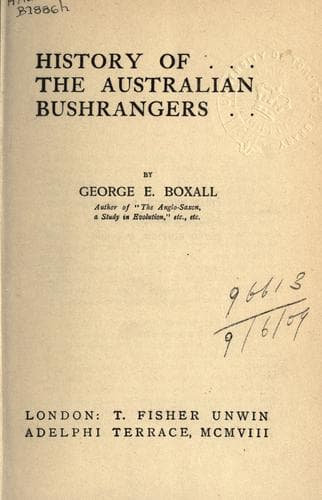
History of the Australian BushrangersBoxall, George
History
History of the Australian Bushrangers
Boxall, George
Bushrangers -- Australia
The robbery of the Bank of Australia does not properly, perhaps, come
under the head of bushranging, but as the later bushrangers made
bank robbery a feature of their depredations the record would not be
complete if this, the first and in some respects the most remarkable of
the bank robberies which have taken place in Australia, was omitted.
The Bank of Australia was established in 1826 and was spoken of as the
"new bank" to distinguish it from the older Bank of New South Wales.
It was also sometimes called "the squatters' bank." Its president was
Mr. John Macarthur, the first of the squatters. It was situated in
George Street, Sydney. The strong room was constructed under ground,
and had walls nine feet thick. Near the foundation of the bank was a
large drain or shore, one of the openings of which was on an unoccupied
plot of ground on the opposite side of the street to that in which
the bank stood. The other end of the drain terminated on the shore
of the harbour. Into this drain the thieves must have entered, and
judging from the amount of work done and the quantity of the remains of
provisions found afterwards they must have been at work for a week or
more. As they were too deep underground for the strokes of their picks
or hammers to be heard, they may have worked night and day. However
that may be, they took the bricks out of the side of the drain facing
the bank and then dug a tunnel until they reached the foundations of
the bank. How they disposed of the earth dug out is not known, but it
was surmised that they carried it away in bags. With great labour they
dislodged a stone at the corner of the foundations, and then gradually
enlarged the hole until there was sufficient room for a man to get
through. Having effected an entrance in this way into the strong room,
they found there forty boxes each containing £100 worth of British
silver coins; a smaller box containing two thousand sovereigns; a box
containing one thousand dollars, and another containing five hundred
dollars. But the robbers took only the two boxes containing dollars
and seven of the forty boxes containing British silver; leaving
thirty-three boxes of silver and the box of sovereigns. They took
also some bundles of bank notes, amounting to between ten and twelve
thousand pounds worth. The forty boxes of silver weighed a ton, and it
was believed that the thieves had been disturbed by some noise before
they had time to remove so great a quantity. The locks on the boxes
left in the vault were found to have been so rusted by damp as to be
useless. No arrests were made and no traces of the robbers could be
found. Notifications were issued denying that the loss, heavy as it
was, would affect the stability of the bank, but it appears that it
never recovered. In 1833 it was re-organised. In 1845 the Government
passed a Lottery Bill to enable the bank to raise money, but to no
purpose. The bank failed in 1848 and caused a great many other failures
and much distress.
Public-domain text, read in full here on John Shaqi.
Reviews
Reviews
No reviews yet
Be the first to share your thoughts on this work.
Elsewhere in the archive
Join the Discussion
Join the discussion
Sign in to leave a comment or review.
Sign InorCreate an account