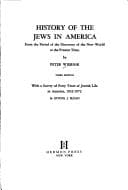
History of the Jews in America: From the Period of the Discovery of the New World to the Present TimeWiernik, Peter
History
History of the Jews in America: From the Period of the Discovery of the New World to the Present Time
Wiernik, Peter
Jews -- America -- History; Jews -- United States -- History
While there were many free thinkers or Deists among the intellectual
leaders of the Revolution, the masses of the colonists were intensely
religious, and an argument from Scripture carried more weight with them
than any other. Education was limited at that period in the colonies;
there were not many newspapers, they were rarely issued more than once
a week, and the number of subscribers was but few. The pulpit had their
place, and the pastors in their sermons dealt with politics not less
than with religion. Sermons were for the people the principal sources
of general instruction. These pastors, in the way of history, knew
above all that of the Jewish people, and they were the first to bring
before their audiences the ideals of the old Hebrew commonwealth. Rev.
Jonathan Mayhew (1720–66), whose discourse, in 1750, against unlimited
submission was characterized as “the morning gun of the Revolution,”
declared in a later oration on the “Repeal of the Stamp Act” which
he delivered in Boston on May 23, 1766: “God gave Israel a king in
His anger because they had not sense and virtue enough to like a free
commonwealth, and to have Himself for their King――where the spirit
of the Lord is there is liberty――and if any miserable people on the
continent or isles of Europe be driven in their extremity to seek a
safe retreat from slavery in some far distant clime――O let them find
one in America.” Rev. Samuel Langdon (1723–97), President of Harvard
College, delivered an election sermon before the “Honorable Congress
of Massachusetts Bay” on the 31st of May, 1775, taking as his text the
passage in Isaiah 1. 26, “And I will restore thy judges as at first,”
in which he said: “The Jewish government, according to the original
constitution, which was divinely established, if considered only in a
civil view, was a perfect republic. And let them who cry up the divine
right of Kings consider, that the form of government which had a proper
claim to a divine establishment was so far from including the idea of a
King, that it was a high crime for Israel to ask to be in this respect
like other nations, and when they were thus gratified, it was rather
as a just punishment for their folly.... The civil polity of Israel is
doubtless an excellent general model, allowing for some peculiarities:
at least some principal laws and orders of it may be copied in more
modern establishments.” Almost everybody at that time knew by heart the
admonitions of Samuel to the children of Israel, describing the manner
in which a King would rule over them.
Public-domain text, read in full here on John Shaqi.
Reviews
Reviews
No reviews yet
Be the first to share your thoughts on this work.
Join the Discussion
Join the discussion
Sign in to leave a comment or review.
Sign InorCreate an account