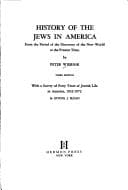
History of the Jews in America: From the Period of the Discovery of the New World to the Present TimeWiernik, Peter
History
History of the Jews in America: From the Period of the Discovery of the New World to the Present Time
Wiernik, Peter
Jews -- America -- History; Jews -- United States -- History
The citizens of the United States of America have the right to
applaud themselves for having given to mankind examples of an
enlarged and liberal policy worthy of imitation. All possess
alike liberty of conscience and immunities of citizenship.
It is now no more that toleration is spoken of as if it were
by the indulgence of one class of people that another enjoyed
the exercise of their inherent natural rights, for happily
the Government of the United States, which gives to bigotry no
sanction, to persecution no assistance, requires only that they
who live under its protection should demean themselves as good
citizens in giving it on all occasions their effectual support.
It would be inconsistent with the frankness of my character
not to avow that I am pleased with your favorable opinion
of my administration and fervent wishes of my felicity.
May the children of the stock of Abraham, who dwell in this
land, continue to merit and enjoy the good will of the other
inhabitants, while everyone shall sit in safety under his own
vine and fig-tree and there shall be none to make him afraid.
May the Father of all mercies scatter light and not darkness in
our paths and make us all in our several vocations useful here
and, in His own due time and way, everlastingly happy.[17]
G. WASHINGTON.
In the year following this correspondence the Synagogue was closed for
lack of attendance, and it was not reopened for nearly a century. The
above-named Moses Seixas, who for many years was cashier of the Bank of
Rhode Island, was one of the last Jews in Newport of that period. Moses
Lopez, the nephew of Aaron, is reputed to have been the last one who
remained there, and ultimately he, too, left for New York, where he
died in 1830. Sentiment caused the descendants of many of the original
families to direct that their remains should be buried in the old
cemetery, where tombstones show interments during the entire period
down to 1855. Abraham Touro (d. in Boston, 1822), the son of Rabbi
Isaac Touro, bequeathed a fund for perpetually keeping the Synagogue
in repair, and also made provisions for the care of the burial ground.
His brother Judah Touro of New Orleans replaced the old cemetery wall
with a massive one of stone, with an imposing granite gateway (1843);
and, at his own request, he himself was buried there. The street on
which the Synagogue is situated is known as Touro Street. The city
also possesses a park known as Touro Park. Though the Touro fund
provided for the support of the minister also, the Synagogue remained
closed until 1883, when the Rev. A. P. Mendes, on appointment by
the Congregation Shearith Israel of New York (which became the legal
proprietor of both Synagogue and cemetery of Newport), became minister
and conducted services until his death in 1891.
* * * * *
Public-domain text, read in full here on John Shaqi.
Reviews
Reviews
No reviews yet
Be the first to share your thoughts on this work.
Elsewhere in the archive
Join the Discussion
Join the discussion
Sign in to leave a comment or review.
Sign InorCreate an account