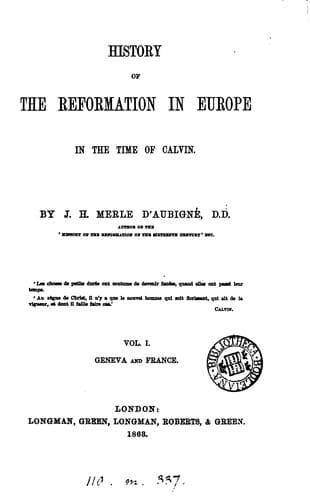
History of the Reformation in Europe in the Time of Calvin, Vol. 6 (of 8)Merle d'Aubigné, J. H. (Jean Henri)
History
History of the Reformation in Europe in the Time of Calvin, Vol. 6 (of 8)
Merle d'Aubigné, J. H. (Jean Henri)
Reformation
was the union of Scotland with England under the sceptre of Henry VIII.
Scotland would in that case have submitted to a reform at the king’s
hand; but she was reserved for other destinies, and her reform was to
proceed from the people, and to be effected by the Word of God.
The King of England was in no lack of motives for intervention in
Scotland. James V. had just concluded an alliance for a hundred years
with Charles V., the mortal enemy of Henry VIII., and had even asked
for the hand of the emperor’s sister, the ex-queen of Hungary. This
princess had rejected the match, and the emperor had proposed to James
his niece Dorothea, daughter of the King of Denmark.
Bothwell was able even to tell Northumberland, in this
night-conference, of matters graver still. A secret ambassador from
Charles V., said he, Peter von Rosenberg, has recently been at
Edinburgh and, in a long conversation which he had with the king in
his private apartments, has promised him that the emperor would put
him in a position, before Easter, to assume the title of _prince of
England_ and duke of York.[163] The Roman party, despairing of Henry
VIII., were willing to transmit the crown to his nephew, the King
of Scotland. Bothwell added that James, as he left the conference,
met the chancellor of the kingdom and several nobles, and made haste
to communicate to them the magnificent promise of Charles V. The
chancellor contented himself with saying, ‘Pray God I may live to see
the day on which the Pope will confirm it.’ The king replied, ‘Only let
the emperor act; he will labor strenuously for us.’ It was not James
V., but his grandson, who was to ascend the throne of the Tudors.
The project formed by the Scottish nobles of placing Scotland under the
sceptre of England was not so easy to carry out as they imagined. The
priests, who supposed that they had surmounted the dangers proceeding
from reform, undertook to remove in like manner those with which they
were threatened by the nobility. But they were mistaken when they
believed that the fire kindled by the Word of God was extinguished.
Flames shot up suddenly even in places where it was least of all
expected to see them.
[Sidenote: ALEXANDER SEATON.]
Public-domain text, read in full here on John Shaqi.
Reviews
Reviews
No reviews yet
Be the first to share your thoughts on this work.
Join the Discussion
Join the discussion
Sign in to leave a comment or review.
Sign InorCreate an account