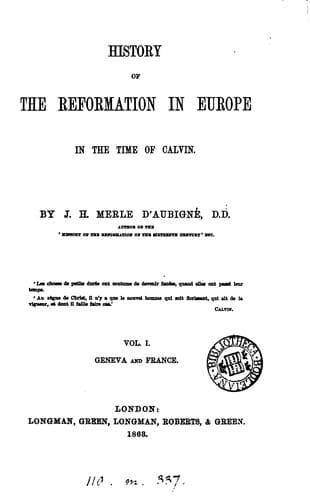
History of the Reformation in Europe in the Time of Calvin, Vol. 8 (of 8)Merle d'Aubigné, J. H. (Jean Henri)
History
History of the Reformation in Europe in the Time of Calvin, Vol. 8 (of 8)
Merle d'Aubigné, J. H. (Jean Henri)
Reformation
But his chief delight was meditation upon the Holy Scriptures. 'The
promises of Christ,' he said, 'allay my sorrows, and I am wonderfully
invigorated by the reading of the Psalms. Eternal God! what abundant
consolation this book has afforded me! With what delight have I tasted
the excellent savor of heavenly wisdom! That lyre of David so ravishes
me with its divine harmony, that heavenly harp excites within me such
love for the things of God, as I can find no words to express.'[149] He
occupied himself in arranging some of the Psalms[150] in the form of
prayers, and went on with his task till he had translated them all.
Francis was not satisfied with meditation alone; he joined with it
deeds of unremitting zeal and charity. The prison discipline was not
severe. The jailer, one John Thyssens, a man of about thirty-eight, had
long carried on the trade of shoemaker, and had afterwards undertaken
by contract the maintenance of the prisoners. He was very negligent in
the discharge of his duties, and allowed a large measure of liberty to
the prisoners and their friends. Inhabitants of Brabant, of Flanders,
of Holland, of Antwerp, and gentlemen of the court came to visit
Enzinas. In this way he saw nearly four hundred citizens of Brussels,
among them some persons of quality. Many of them were acquainted with
the Gospel; others were ardently longing for the word of God, and
entreated Enzinas to make it known to them. He knew the danger to which
he exposed himself by doing this, but he did not spare himself; and
many gave glory to God because they had received from a poor prisoner
the pearl of great price, the heavenly doctrine. 'There are more than
seven thousand people in Brussels who know the Gospel,' they told him;
'the whole city is friendly to it;[151] and were not the people in fear
of their lives they would openly profess it.' It was hardly possible to
name a single town in Belgium or in Holland whose inhabitants had not
a desire to converse with him. He was a captive who proclaimed liberty
to free men. 'The word of God,' some of them told him, 'is making great
way amongst us. It grows and spreads day by day in the midst of the
fire of persecution and the terrors of death.' Both men and women sent
him money, but this he declined to accept.
Charles the Fifth, who, as we have seen, had arrived at Brussels on
November 24, 1543, only remained there till January 2, 1544. On
February 20 he opened the diet of Spire, demanded large aids both of
infantry and cavalry, and in June set out at the head of his army for
France. He took Saint-Dizier, advanced within two days' march of Paris,
causing great terror in that city, and concluded peace at Crépy. He
then returned to his own dominions, and entered Brussels October 1,
1544.[152]
[Sidenote: HOPES.]
Public-domain text, read in full here on John Shaqi.
Reviews
Reviews
No reviews yet
Be the first to share your thoughts on this work.
Join the Discussion
Join the discussion
Sign in to leave a comment or review.
Sign InorCreate an account