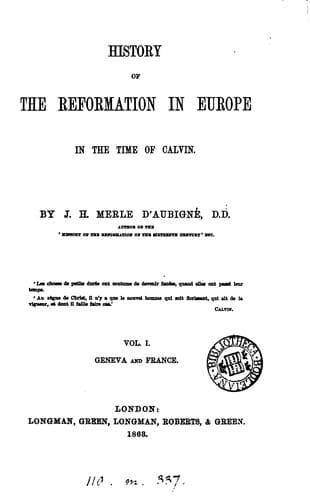
History of the Reformation in Europe in the Time of Calvin, Vol. 8 (of 8)Merle d'Aubigné, J. H. (Jean Henri)
History
History of the Reformation in Europe in the Time of Calvin, Vol. 8 (of 8)
Merle d'Aubigné, J. H. (Jean Henri)
Reformation
This news awakened hopes for Enzinas on the part of his kinsmen at
Antwerp, and the most influential among them immediately set out to
solicit the release of the young man. They appealed to the confessor,
who was ready enough to make promises, to the chancellor Granvella,
to his son the bishop of Arras, afterwards archbishop of Mechlin and
cardinal, and to Claude Boissot, dean of Poligny, master of requests.
They all gave kind answers, but these were words and nothing else. The
queen of France visited Brussels, and a report was spread that all
prisoners would at her request be liberated. Some murderers, brigands,
and other malefactors were, indeed, set free; the first of them was a
parricide; but Enzinas and the other evangelicals were more strictly
and severely kept than before.[153] At the same time, the emperor
having gone to Ghent, the monks extorted from him some laws _written
in blood_, which were promulgated in all the towns, and which enabled
them cruelly to assail the Lutherans at their own pleasure.[154] 'On a
sudden there broke out in Flanders a bloody persecution, a slaughter of
Christian people, such as had never been seen or heard of.' From all
the towns, not excepting even the smallest, a great number of people
and of leading men, on being warned of the danger which was impending
over them, took flight, leaving their wives, their children, their
families, houses, and goods, which were forthwith seized by the agents
of the emperor. But there was a large number who could not fly. All
the towers were filled. The prisons in the towns had not room to hold
the victims. They brought in two hundred prisoners at a time, both men
and women. Some of them were thrust into sacks and thrown into the
water; others were burned, beheaded, buried alive, or condemned to
imprisonment for life. The like storm swept over Brabant, Hainault, and
Artois. The unhappy witnesses of this butchery asserted that 'for many
ages so many and great cruelties had not been perpetrated, nor seen,
nor heard of in all the world.' Such was the joyful entry which Charles
the Fifth made into his good country of Flanders and the good town of
Ghent, in which he was born.
Tidings of these things were brought day by day into the prison at
Brussels, frequently with a large number of captives. When Enzinas and
his friends heard of the slaughter they were amazed and terrified. Will
there be any end to this? they asked. It might well be doubted whether
such men would ever be satiated with the blood of their fellow-men!
Enzinas began to regret that, from confidence in his own innocence,
and for fear of bringing the jailer into disgrace, he had not availed
himself of several opportunities which had offered of making his escape
from prison. A circumstance which soon occurred helped to bring him to
a decision.
Public-domain text, read in full here on John Shaqi.
Reviews
Reviews
No reviews yet
Be the first to share your thoughts on this work.
Join the Discussion
Join the discussion
Sign in to leave a comment or review.
Sign InorCreate an account