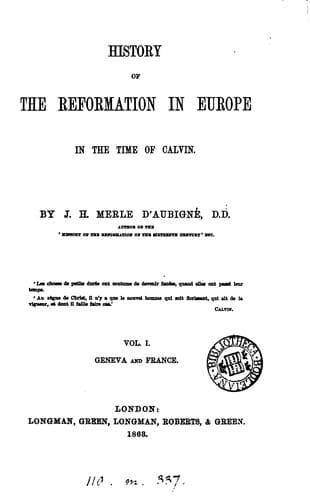
History of the Reformation in Europe in the Time of Calvin, Vol. 8 (of 8)Merle d'Aubigné, J. H. (Jean Henri)
History
History of the Reformation in Europe in the Time of Calvin, Vol. 8 (of 8)
Merle d'Aubigné, J. H. (Jean Henri)
Reformation
He might, doubtless, have quitted Rome by stratagem, and have secretly
escaped. But he was too candid entirely to conceal his purpose. One
of his countrymen was informed of it and hastened to denounce him
to the Inquisition as a heretic. James was then arrested and thrown
into strict confinement. His arrest made a great noise. A Spaniard
accused of Lutheranism! A man of learning and of an ancient family
opposed to the Church! An enemy of the pope living close by the pope!
What strange things! The Inquisition, therefore, determined to make
of this trial an imposing affair. There was 'a great assembly of the
Romans' to attend at his examination. James appeared in the presence
not only of the inquisitors, but also of the cardinals, bishops, and
all Spaniards of eminence then at Rome, and of several members of the
Roman clergy. If the popes had been unable, notwithstanding their
efforts, to keep Luther in their hands, they had now at least one of
his disciples in their power. James Enzinas, in the presence of this
imposing assembly, perceived that God gave him suddenly, and at Rome
itself, an opportunity of glorifying him and of doing, once for all,
the work to which he had desired to consecrate his whole life. He
took courage. He understood perfectly well that the 'lion's mouth'
was opening before him, the gulf of death. But neither the solemnity
of the hour, nor the brilliancy of the court, nor the thought that he
was about to be swept away by a fatal stroke, nor all that was dear
to him on earth, could make him swerve from the straight path. 'He
maintained with great constancy,' says the chronicler, 'and with holy
boldness the true doctrine of the Gospel.' He did more. Standing thus
in the presence of the princes of the Roman church, and of all their
pomp, he thought that fidelity required him to expose their errors. 'He
forthwith condemned,' says the narrator, 'the impieties and diabolical
impositions of the great Roman antichrist.' At these words a thrill ran
through the assembly. The whole court was in commotion. The prelates,
annoyed at what they heard, were agitated as if under the influence
of some acute nervous irritation. They cried out in astonishment and
anger. The Spaniards especially could not contain themselves. 'All at
once, not only the cardinals, but those of his own country who were
present, began to cry aloud that he ought to be burnt.'[164]
[Sidenote: HIS MARTYRDOM.]
Public-domain text, read in full here on John Shaqi.
Reviews
Reviews
No reviews yet
Be the first to share your thoughts on this work.
Join the Discussion
Join the discussion
Sign in to leave a comment or review.
Sign InorCreate an account