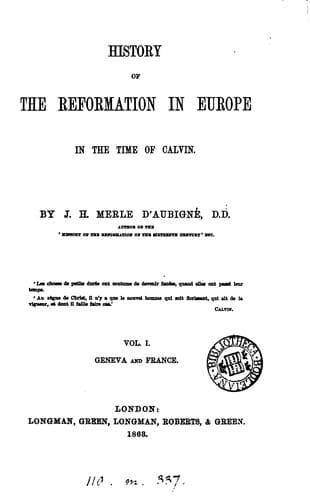
History of the Reformation in Europe in the Time of Calvin, Vol. 8 (of 8)Merle d'Aubigné, J. H. (Jean Henri)
History
History of the Reformation in Europe in the Time of Calvin, Vol. 8 (of 8)
Merle d'Aubigné, J. H. (Jean Henri)
Reformation
In this metropolis was a brother of Juan Diaz, named Alonzo, an
advocate practising before the Roman tribunals. Marquina related to
him all that he had heard about Juan. Alonzo loved his brother, but
he loved Rome still more. At this news, therefore, he was plunged into
a deep melancholy. Juan a heretic! What a misfortune for him, but what
an offence also against the Church! Alonzo, though not a thorough
bigot, was violent, and was smitten with that gloomy and cruel madness
which fancies that it is defending the church of God when persecuting
those who hold contrary doctrines. He was not without affection for
those of his own kin; but he was pitiless towards them if ever they
attacked the faith. He would rather they should all perish than be
guilty of an outrage against the Church. He was not only superstitious
but fanatical; and fanaticism is to superstition what delirium is to
fever. As soon as he was informed of the letters which Malvenda had
written to the confessor, Alonzo determined to go to Germany and to
make use of all available means to bring back his brother to the faith
or to retrieve the injury done by him to the Church. He selected as his
servant a man of evil repute, took post and went with the utmost speed
to Augsburg, and thence to Ratisbon, where he expected to find his
brother. This journey was made in March, 1546. The conference was just
on the point of closing without having accomplished any thing, and Juan
Diaz had already left Ratisbon.
Alonzo was greatly annoyed at this news, and resolved to have an
interview without delay with Malvenda. The latter had no hesitation as
to what was to be done. 'May I live to see the day,' said he, 'on which
Juan Diaz will be burnt ... and his soul thus be saved.' 'A brutal
speech,' says Crespin, the friend of Juan, 'altogether diabolical and
worthy of eternal wrath.' But in those times of error, when people
fancied that false doctrine ought to be punished like any ordinary
crime, it is possible that this priest, in uttering the wish that the
soul should be saved at the cost of the body, might imagine that it
was really a pious and charitable speech. The human understanding was
then, and had been for ages, profoundly and miserably mistaken on this
matter.
Public-domain text, read in full here on John Shaqi.
Reviews
Reviews
No reviews yet
Be the first to share your thoughts on this work.
Elsewhere in the archive
Join the Discussion
Join the discussion
Sign in to leave a comment or review.
Sign InorCreate an account