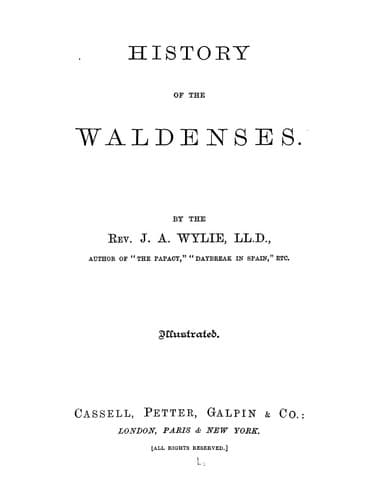
History of the WaldensesWylie, J. A. (James Aitken)
History
History of the Waldenses
Wylie, J. A. (James Aitken)
Church history -- Middle Ages, 600-1500; Waldenses
The tocsin was rung out from the Monastery of Pinerolo. Perched on the
frontier of the Valleys, the monks of this establishment kept their
eyes fixed upon the heretics of the mountains, as vultures watch their
prey, ever ready to sweep down upon hamlet or valley when they found
it unguarded. They hired a troop of marauders, whom they sent forth to
pillage. The band returned, driving before them a wretched company of
captives, whom they had dragged from their homes and vineyards in the
mountains. The poorer sort they burnt alive, or sent to the galleys;
the rich they imprisoned till they had paid the ransom to which they
were held.[56]
The example of the monks was followed by certain Popish landlords in
the Valley of San Martino. The two seigneurs of Perrier attacked,
before day-break of April 2nd, 1560, the villagers of Rioclareto, with
an armed band. Some they slaughtered, the rest they drove out, without
clothes or food, to perish on the snow-clad hills. The ruffians who
had expelled them took possession of their dwellings, protesting that
no one should enter them unless he were willing to go to mass. They
kept possession only three days, for the Protestants of the Valley of
Clusone, to the number of 400, hearing of the outrage, crossed the
mountains, drove out the invaders, and reinstated their brethren.[57]
Next appeared in the Valleys, Philip of Savoy, Count de Raconis, and
Chief Commissioner. He was an earnest Roman Catholic, but a humane and
upright man. He attended sermon one day in the Protestant church of
Angrogna, and was so much pleased with what he heard, that he obtained
from the pastor an outline of the Vaudois faith, so as to send it to
Rome, in the hope that the Pope would cease to persecute a creed that
seemed so little heretical. A sanguine hope truly! Where the honest
Count had seen very little heresy, the Pope, Pius IV., saw a great
deal; and would not even permit a disputation with the Waldensian
pastors, as the Count had proposed. He would stretch his benignity no
further than to absolve “from their past crimes” all who were willing
to enter the Church of Rome. This was not very encouraging, still the
count did not abandon his idea of conciliation. In June, 1560, he came
a second time to the Valley of Lucerna, accompanied by his colleague,
La Trinita, and assembling the pastors and heads of families, he told
them that the persecution would cease immediately, provided they would
consent to hear the preachers he had brought with him, _Brothers of
the Christian Doctrine_. He further proposed that they should silence
their own ministers while they were making trial of his. The Vaudois
expressed their willingness to consent, provided the count’s ministers
preached the pure Gospel; but if they preached human traditions,
they (the Vaudois) would be under the necessity of withholding their
consent; and, as regarded silencing their own ministers, it was only
reasonable that they should be permitted first to make trial of the
Public-domain text, read in full here on John Shaqi.
Reviews
Reviews
No reviews yet
Be the first to share your thoughts on this work.
Elsewhere in the archive
Join the Discussion
Join the discussion
Sign in to leave a comment or review.
Sign InorCreate an account