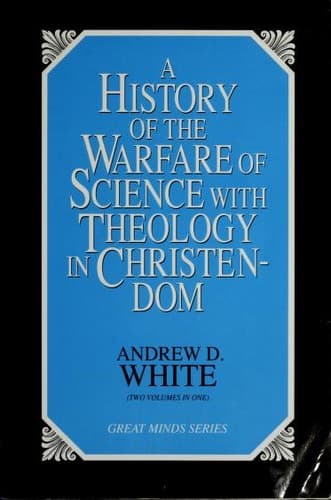
History of the Warfare of Science with Theology in ChristendomWhite, Andrew Dickson
Religion
History of the Warfare of Science with Theology in Christendom
White, Andrew Dickson
Religion and science -- History
In the light of these two evolutions, then--one of the visible universe,
the other of a sacred creation-legend--science and theology, if the
master minds in both are wise, may at last be reconciled. A great
step in this reconciliation was recently seen at the main centre
of theological thought among English-speaking people, when, in the
collection of essays entitled Lux Mundi, emanating from the college
established in these latter days as a fortress of orthodoxy at Oxford,
the legendary character of the creation accounts in our sacred books was
acknowledged, and when the Archbishop of Canterbury asked, "May not the
Holy Spirit at times have made use of myth and legend?"(10)
(10) For the first citations above made, see The Cosmogony of Genesis,
by the Rev. S. R. Driver, D.D., Canon of Christ Church and Regius
Professor of Hebrew at Oxford, in the Expositor for January, 1886; for
the second series of citations, see the Early Narratives of Genesis, by
Herbert Edward Ryle, Hulsean Professor of Divinity at Cambridge, London,
1892. For evidence that even the stiffest of Scotch Presbyterians have
come to discard the old literal biblical narrative of creation and
to regard the declaration of the Westminster Confession thereon as
a "disproved theory of creation," see Principal John Tulloch,
in Contemporary Review, March, 1877, on Religious Thought in
Scotland--especially page 550.
II. THEOLOGICAL TEACHINGS REGARDING THE ANIMALS AND MAN.
In one of the windows of the cathedral at Ulm a mediaeval glass-stainer
has represented the Almighty as busily engaged in creating the animals,
and there has just left the divine hands an elephant fully
accoutred, with armour, harness, and housings, ready-for war. Similar
representations appear in illuminated manuscripts and even in early
printed books, and, as the culmination of the whole, the Almighty is
shown as fashioning the first man from a hillock of clay and extracting
from his side, with evident effort, the first woman.
This view of the general process of creation had come from far,
appearing under varying forms in various ancient cosmogonies. In
the Egyptian temples at Philae and Denderah may still be seen
representations of the Nile gods modelling lumps of clay into men, and
a similar work is ascribed in the Assyrian tablets to the gods of
Babylonia. Passing into our own sacred books, these ideas became the
starting point of a vast new development of theology.(11)
(11) For representations of Egyptian gods creating men out of lumps
of clay, see Maspero and Sayce, The Dawn of History, p. 156; for the
Chaldean legends of the creation of men and animals, see ibid., p. 543;
see also George Smith, Chaldean Accounts of Genesis, Sayce's edition,
pp. 36, 72, and 93; also for similar legends in other ancient nations,
Lenormant, Origines de l'Histoire, pp. 17 et seq.; for mediaeval
representations of the creation of man and woman, see Didron,
Iconographie, pp. 35, 178, 224, 537.
Public-domain text, read in full here on John Shaqi.
Reviews
Reviews
No reviews yet
Be the first to share your thoughts on this work.
Join the Discussion
Join the discussion
Sign in to leave a comment or review.
Sign InorCreate an account