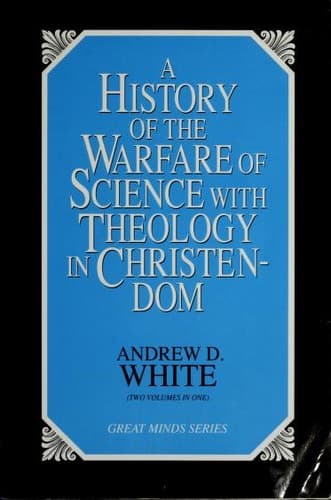
History of the Warfare of Science with Theology in ChristendomWhite, Andrew Dickson
Religion
History of the Warfare of Science with Theology in Christendom
White, Andrew Dickson
Religion and science -- History
The fathers of the Church generally received each of the two conflicting
creation legends in Genesis literally, and then, having done their best
to reconcile them with each other and to mould them together, made them
the final test of thought upon the universe and all things therein. At
the beginning of the fourth century Lactantius struck the key-note of
this mode of subordinating all other things in the study of creation to
the literal text of Scripture, and he enforces his view of the creation
of man by a bit of philology, saying the final being created "is called
man because he is made from the ground--homo ex humo."
In the second half of the same century this view as to the literal
acceptance of the sacred text was reasserted by St. Ambrose, who, in his
work on the creation, declared that "Moses opened his mouth and poured
forth what God had said to him." But a greater than either of them
fastened this idea into the Christian theologies. St. Augustine,
preparing his Commentary on the Book of Genesis, laid down in one famous
sentence the law which has lasted in the Church until our own time:
"Nothing is to be accepted save on the authority of Scripture, since
greater is that authority than all the powers of the human mind." The
vigour of the sentence in its original Latin carried it ringing down the
centuries: "Major est Scripturae auctoritas quam omnis humani ingenii
capacitas."
Through the mediaeval period, in spite of a revolt led by no other
than St. Augustine himself, and followed by a series of influential
churchmen, contending, as we shall hereafter see, for a modification of
the accepted view of creation, this phrase held the minds of men firmly.
The great Dominican encyclopaedist, Vincent of Beauvais, in his Mirror
of Nature, while mixing ideas brought from Aristotle with a theory
drawn from the Bible, stood firmly by the first of the accounts given in
Genesis, and assigned the special virtue of the number six as a reason
why all things were created in six days; and in the later Middle Ages
that eminent authority, Cardinal d' Ailly, accepted everything regarding
creation in the sacred books literally. Only a faint dissent is seen
in Gregory Reisch, another authority of this later period, who, while
giving, in his book on the beginning of things, a full length woodcut
showing the Almighty in the act of extracting Eve from Adam's side,
with all the rest of new-formed Nature in the background, leans in his
writings, like St. Augustine, toward a belief in the pre-existence of
matter.
Public-domain text, read in full here on John Shaqi.
Reviews
Reviews
No reviews yet
Be the first to share your thoughts on this work.
Join the Discussion
Join the discussion
Sign in to leave a comment or review.
Sign InorCreate an account